
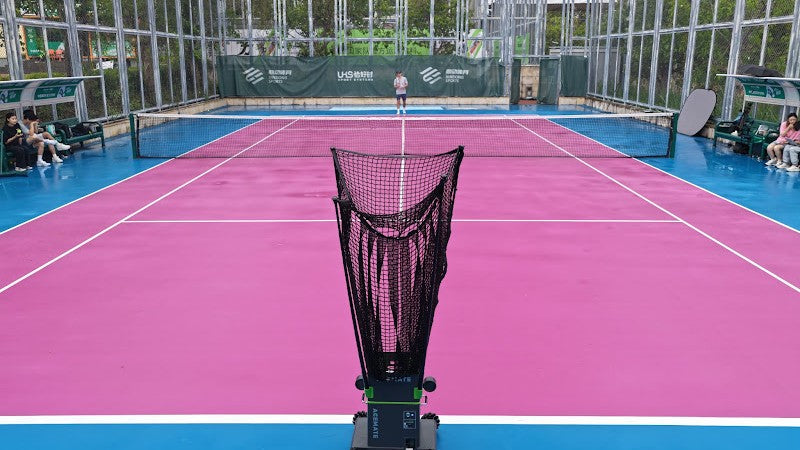
Ball machine practice usually fails to transfer to matches because a fixed feed removes three things a match always supplies: information before the ball is struck, consequences after it, and a score that makes both matter. You still get real swings, real contact, and real volume, so the strokes look clean inside the drill. Then a match starts, the ball comes off a racquet instead of out of a machine, and the same swing runs late. The problem is rarely technique, and the fix is rarely fewer machine sessions. It is changing what each ball is asked to do, so the session trains reading, recovery, and shot choice instead of contact alone.
Five Reasons Ball Machine Practice Does Not Transfer to Matches
A standard machine session trains the swing and leaves five match skills largely untouched: reading the ball before it is hit, recovering under rally consequences, choosing between options under time, holding mechanics while the score matters, and adapting when the shot changes from one ball to the next. None of these gaps is dramatic on its own. Together they explain a familiar pattern: the drill score keeps improving and the match record does not.
You Time the Ball, Not the Opponent
Against a machine you can only start from the ball, because there is no stance, no toss, and no racquet path to read before it. In a match, most of your preparation is triggered by what the opponent does in the half second before contact.
That difference shows up in measurable timing. Carboch, Süss, and Kocib put two groups of seven male players ranked in the top 200 of the Czech national system on an indoor court and had them hit forehand returns, one group against a ball machine set to imitate a serve, the other against a live server. Ball speeds ran from about 59 to 84 mph, giving roughly one second of flight. Measured from the moment the ball was released or struck, the machine group started moving earlier, with a median movement initiation of 0.38 seconds against 0.41 seconds for the live server, and then held a longer backswing, a median of 0.59 seconds against 0.49 seconds. Forward swing duration was the same for both groups. Their 2014 study in the Journal of Sports Science and Medicine also lists its own limits: two separate groups rather than repeated measures, forehand returns only, and a small sample.
The direction of that difference is the useful part. With no pre-contact cues, players against the machine started as soon as possible and stretched the swing to fill the time. Facing a real server, players could wait, read the toss and arm, and then work with a shorter, more compact backswing. A backswing built around one second of guaranteed warning becomes a late backswing when the warning disappears.
Quick self-check: if your first three or four returns and first-ball groundstrokes in a match feel jammed while the same shots feel comfortable off the machine, this is the gap you are seeing.

The Machine Does Not React to Your Last Shot
In a machine drill, the next ball is unaffected by the shot you just hit. That single fact removes most of what tennis tactics are built on. In a rally, a short reply gets punished, a heavy crosscourt buys you time, and a ball that lands three feet inside the baseline changes what comes back. Practice against a fixed feed teaches you to produce shots without ever teaching you what your shots produce.
The same break shows up in movement. Because the next ball arrives on a timer whether or not you recovered, many players quietly stop recovering, and because the feed is aimed at a fixed spot, the ball keeps arriving at a comfortable contact point instead of forcing you to hit on the run. The drill still works, the contact points still feel good, and the habit goes unnoticed until a match punishes it. This is why recovery footwork deserves the same attention in a machine session that it gets in live hitting.
Quick self-check: film one drill block from behind. If you are standing still when the next ball launches, the feed is doing your recovery for you.
Preset Patterns Remove Your Shot Selection
A preset pattern tells you where the ball is going before it leaves the machine, so the drill removes the decision a match forces on every ball. In a match, the choice happens before the swing and under time pressure. Off the machine, the choice was made before the drill started.
A player who executes a crosscourt forehand cleanly in practice and then pulls it down the line into the doubles alley at 4-all has not lost the stroke. They lost the selection, which is a separate skill, and one that a fixed sequence never touches. Studying tour-level baseline patterns is more useful here than adding another placement drill, because it tells you which choices are worth rehearsing.
A Drill With No Score Removes Match Pressure
Practice that always starts from zero never rehearses the moments where mechanics break down. Matches do not fail evenly across a set. They fail at 30-30, on break points, and when serving for the set, because those are the points where breathing shortens, tempo changes, and shot selection turns conservative.
A machine session removes all of it. Nothing is at stake, a miss costs nothing, and the next ball arrives regardless. That is useful when you are grooving a change and useless when you are trying to make the change survive competition.
Quick self-check: compare your first-serve percentage and unforced error count in the opening two games of a set with the games where you serve at 4-5. If the gap is large, the missing training is pressure, not technique.
Blocked Repetition Improves the Drill, Not the Match
Hitting the same shot in a long block raises your score inside that block faster than it raises your match level, and the two are easy to confuse.
Buszard, Reid, and colleagues tested serve practice under low and moderate contextual interference in skilled youth tennis players. The low interference group improved on the skill test but not on the transfer test. The moderate interference group showed no change on the skill test and improved on the transfer test. The schedule that produced the better drill score produced the weaker transfer, and their 2017 paper in Frontiers in Psychology concluded the usual effect is less clear for a skill as complex as the serve.
Treat variability as a lever to test rather than a law. A 2023 systematic review of 37 sport-skill studies found only about a fifth of pooled outcomes across acquisition, retention, and transfer supported the contextual interference effect. The practical version survives that debate either way: judge a drill by what it does to your next match, not by how clean it felt.

How to Make Ball Machine Practice Transfer to Matches
Keep the machine and change four things about the session: how the feed is ordered, where you recover to, what you have to decide, and what counts. Those four changes turn tennis practice on a feed into something closer to realistic practice, and they cost nothing beyond attention.
Move From Blocked to Serial to Random Feeds
Advice on this usually stops at randomizing the feed, which skips the stage that matters. Practice scheduling has three stages, and each shot should climb them in order.
- Blocked. The same shot repeated, such as thirty crosscourt forehands. Use it while a technical change is new and you cannot yet produce the shape on demand.
- Serial. A fixed cycle repeated in the same order, such as deep forehand, short backhand, high forehand, over and over. You know what is coming, but you have to change shot on every ball. This is the stage that usually gets skipped.
- Random. The same shots in an order you cannot predict, so reading the incoming ball becomes the first job.
On the Acemate S10, a serial cycle is built by editing shots individually: each shot in a sequence carries its own direction, spin, speed on a 1 to 10 scale, and elevation between 10 and 40 degrees, so one cycle can alternate a heavy deep ball with a low short one. Getting those speeds close to real match pace is worth doing before you layer variation on top, since a slow feed with lots of variation still trains a slow game.
Two conditions shape how far you can climb. The shot interval in the app stays constant across a sequence, so unpredictability has to come from ball type and placement rather than from surprise timing. And any preset sequence eventually becomes learnable, so build the random stage from a longer non-repeating sequence of eight to ten shots, or have a partner start it while your back is turned. How long a sequence you can build depends on the machine, since programmable and AI models allow custom shot lists that a fixed automatic feeder does not.
Recover to a Real Position After Every Ball
Set the feed interval long enough to complete a genuine recovery step and a split step before the next launch, then shorten it as the pattern becomes familiar. The Acemate S10 app allows intervals from 1 to 10 seconds, which is enough range to start deliberate and compress later. Switching to recovery-based feeding changes a drill more than the interval number itself.
The rule is simple: if you cannot get back to your recovery position before the next ball leaves the machine, the drill is training a stationary swing. Slow the feed rather than skipping the reset, and place enough targets wide that you finish some shots moving, which is what side-to-side oscillation is for.
Add a Decision Before Every Swing
Decision making drills cost nothing to add, because they need no equipment change at all. Convert a placement drill into a choice by adding a rule that resolves only after the ball is in flight:
- Call your target out loud after the ball crosses the net, not before, and hit the one you called.
- Use a depth rule: any ball landing behind the service line goes crosscourt with height, anything shorter goes down the line and you move in.
- Change something deliberately on every fourth ball, either the rhythm or the pace, so acceleration becomes a decision rather than an accident.
Each rule forces you to read the incoming ball first and commit second, which is the order a match uses.
Play Every Drill for a Score
Add a consequence, and start the count where matches get difficult rather than at zero:
- Start every game at 30-30, so each point is played close.
- Play sets that start at 4-4, so every service game is a closing game.
- Use a reset rule: two errors in a row and the count returns to the start.
- Serve before each sequence so the rally begins the way match rallies begin.
Scoring changes breathing, tempo, and shot selection in a way that no amount of unscored repetition does.
The one change a fixed feed cannot make on its own is putting your last shot back into the exchange. That is what machines that return your shots are for. In rally mode, the Acemate S10 tracks the ball, moves to it, and returns it, so the next ball arrives when the rally produces it rather than when a timer expires, and recovery stops being optional. Rally mode runs on a standard court with clear boundary lines, and you should stay at least 2 meters from the robot, about 6.5 feet, whenever rally mode is running. Machine work supports playing points rather than replacing them.
The Acemate S10 Pro extends that progression across five training modes: Ball Machine, Drill, Rally, Serve, and Battle. That lets a session move from controlled repetition and preset drills into live returns, serve-plus-one practice, and match-style challenges without treating every ball the same. The S10 Pro also offers 100+ preset drills and custom control over speed, spin, placement, trajectory, and tempo, so the added variation can be built around the skill you are trying to transfer rather than added for its own sake.
A 60-Minute Ball Machine Session That Transfers to Match Play
The structure below keeps the volume that makes machine work valuable and moves the last third toward match simulation drills.
|
Phase |
Time |
What to Set |
What It Trains |
|
Blocked warm-up |
10 min |
One shot, one target, longer interval |
Contact quality and rhythm |
|
Serial cycles |
15 min |
A 3 or 4 shot cycle varying depth, height, and spin; full recovery between balls |
Adjustment and reset |
|
Random plus decision |
15 min |
Longer non-repeating sequence, target called after the ball crosses the net |
Reading and shot selection |
|
Scored games |
20 min |
Games starting at 30-30, reset after two errors in a row, serve to start |
Mechanics under pressure |
The first 25 minutes look like a normal session. The last 35 are what most sessions are missing, and they are the part that shows up in a match.
How to Tell If Your Practice Is Transferring
Judge transfer by your next two or three matches, not by how the drill felt. Useful markers are specific and observable:
- The first ball after your serve stops feeling rushed.
- The opening two games of a set no longer feel faster than practice.
- Your level holds at 30-30 and on break points instead of dropping there.
- Your errors shift away from timing faults such as late contact, jammed shots, and balls off the frame, and toward choice errors, which are easier to identify and correct.
- You can name the target you intended on most points, including the ones you missed.
Session data helps if you compare whole sessions rather than single drills. Acemate S10 training records include total shots, average and maximum speed, average net clearance, and the in/out rate, along with a landing distribution map, so a session built on serial cycles and one built on blocked repetition can be compared on the numbers instead of by feel. Your ball placement data tells you more than any single good drill does.
If four to six weeks of redesigned sessions change nothing in matches, the limiting factor is probably elsewhere, most often serve consistency, fitness late in sets, or simply not playing enough competitive sets. At that point a coach watching your match play is worth more than another machine setting, and what a machine can coach is worth understanding before you assume the settings are the problem.
When Blocked Repetition Is Still the Right Choice
Blocked repetition is the right choice when you are changing a technical element, returning from a layoff, or learning a shot you cannot yet produce on demand. In those cases the goal is producing the shot at all, and variability only adds noise.
The switch point is practical rather than numerical: once you can produce the change without thinking about it, move the shot up to serial cycles, then to random feeds and scored games. Beginners in particular benefit from consolidating a repeatable swing before adding decisions, and a weekly practice plan keeps one from crowding out the other across a season.
Frequently Asked Questions
Do Pros Use Ball Machines?
Yes. Machines are a regular part of professional and academy programs, mainly for warm-up and high-volume work on a single shot. Pinder, Renshaw, Davids, and Kerhervé note in Sports Medicine that they also reduce injury incidence for players and coaches. Watching pro practice sessions shows the same split, with machine work sitting alongside sparring and set play.
Is It Worth Getting a Tennis Ball Machine?
Yes, if you plan to design sessions rather than only feed yourself balls. A machine gives you volume, repeatable placement, and court time without a partner, which is hard to arrange any other way. Tested model reviews show what each price tier buys, though whether AI features pay off still comes down to session design.
Should I Hit Fewer Balls in a Machine Session?
Not fewer balls, fewer identical ones. Volume is what a machine is genuinely good at, and cutting it throws away the main advantage. A 300-ball session built from serial cycles, enforced recovery, and scored games transfers better than 300 repetitions of one shot, at the same cost in court time.
What If I Have No One to Play Practice Sets With?
Build the match elements you can create alone: scoring, serving before each rally, a decision rule on every ball, and full recovery between shots. Those four cost nothing. Rally-capable machines restore the continuous exchange, and leagues, ladders, or club matches cover the rest. Sessions spent practicing alone transfer when they are built around match elements, not around volume.
