
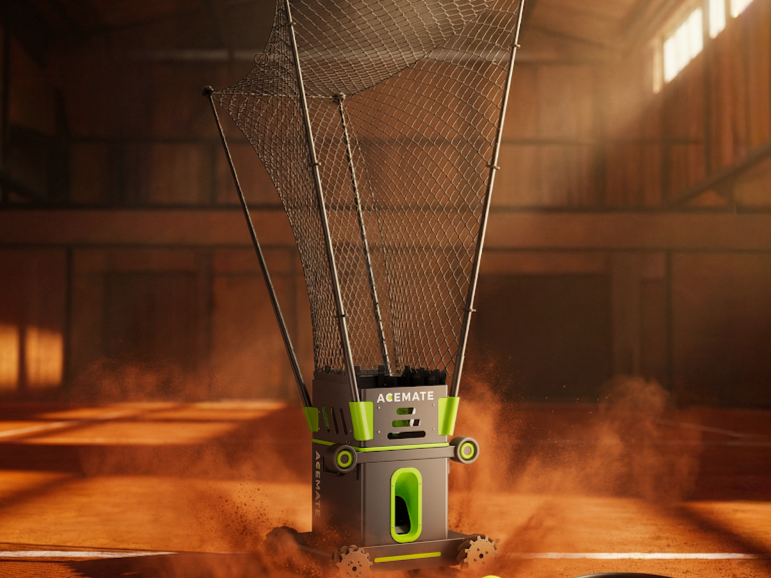
Blocked practice repeats the same shot from the same feed. Random practice mixes shots so you recognize the ball before you swing. Use blocked practice when a stroke is new or has stopped working, and random practice when the stroke exists but does not hold up in matches. On a ball machine, blocked practice is one shot on a fixed setting, and random practice is a long sequence varying direction, depth, spin, and speed. Most machine work lands between the two, since a programmed sequence repeats in a fixed order. That middle category is called serial practice, and it has its own uses.
Why Random Practice Feels Worse and Works Better
Random practice produces more errors during the session and better retention afterward. The difference is in what you have to do between balls. In a blocked set, after three repetitions the answer is already loaded, so you execute without re-solving anything. In a random set, every ball forces you to identify what is coming and rebuild the response, and that rebuilding is what gets stored.
Motor learning calls the effect contextual interference. Mixing tasks interferes with performance now and improves it later, which is why the same practice that feels productive is often the one teaching you least.
The practical consequence is a change in how you read a session. A blocked set that goes well tells you the stroke works under easy conditions. A random set that goes badly tells you very little on its own, because errors are part of the mechanism rather than a verdict on the day.
Blocked, Serial, and Random Compared
Three categories exist, not two, and the middle one is where most ball machine practice actually sits. Serial practice varies the shots but keeps them in a fixed, repeating order, which is exactly what a programmed sequence does.
|
Dimension |
Blocked |
Serial |
Random |
|
What the feed does |
The same ball every time |
Several different balls in a fixed, repeating order |
Different balls in an order you cannot predict |
|
What you have to solve |
Execution only |
Execution plus recall of the order |
Recognition, choice, and execution |
|
Contextual interference |
Low |
Moderate |
High |
|
Performance during the session |
Highest |
Middle |
Lowest |
|
Retention into the next session |
Lowest |
Middle |
Highest |
|
Best used for |
A new or broken stroke |
Learning a pattern or a rally shape |
Match readiness, footwork, and decisions |
|
Feed interval |
Steady, 4 to 5 seconds |
Steady, 5 to 6 seconds |
5 to 6 seconds at first, match tempo later |
|
Set length |
20 to 25 balls |
Two or three loops of the sequence |
30 balls or more |
|
How to judge it |
Contact quality inside the set |
Whether the pattern holds when the order changes |
Accuracy at the start of the next session |
|
Main failure mode |
Repeating without adjusting |
Memorizing the order instead of reading the ball |
Too many variables at once to learn anything |
Serial practice is not a compromise. It is the right tool for anything with a natural order, like a serve plus one pattern or a short-ball approach, where the sequence itself is the thing you are learning.
Which One You Need Right Now
Match the practice type to the state of the stroke rather than to your rating.
|
Situation |
Use |
Starting split |
|
Learning a new grip, stance, or swing path |
Blocked |
80 percent blocked |
|
A stroke that broke down this month |
Blocked, then random in the same session |
60 percent blocked |
|
A stroke that works in practice but not in matches |
Random |
70 percent random |
|
A rally pattern you want to own |
Serial |
60 percent serial |
|
Footwork and recovery |
Random |
80 percent random |
|
The week before a match |
Random with short blocked blocks |
70 percent random |
|
First session back after a layoff |
Blocked |
90 percent blocked |
Blocked practice builds, serial practice organizes, and random practice tests. As a stroke matures, the split shifts away from blocked and toward random, which is one of the ways training needs change from beginner to advanced.
How to Set Up Blocked Practice on a Ball Machine
Program a single shot and leave every setting alone for the whole block. On the Acemate S10 that means one direction, one speed on the 1 to 10 dial, one spin value, one elevation, and a steady interval around 4 to 5 seconds. The preset fixed-point drills do this without any programming.
Cap the block at 20 to 25 balls, then step back for a few seconds. Past that point most players stop adjusting and start repeating. The pause is part of the drill, since evaluating what just happened is what turns repetition into learning.
Change one variable between blocks, never inside them. Run 20 balls, change the depth, run 20 more. Changing settings mid-block produces a weak version of serial practice with none of the benefit of either.
Watch one thing per block. Contact point, or net clearance, or the recovery step. Blocked practice earns its place by freeing up attention, and that only pays off if you spend the freed attention deliberately.
Blocked sets are also where a change from a coach belongs, since the feedback arrives every few seconds and the ball never surprises you. The preset drill library covers most of what a blocked set needs.

How to Set Up Random Practice on a Ball Machine
Build one long sequence that varies several things at once, then add the variation that has to come from you. Add eight to twelve shots and give each its own direction, speed, spin, and elevation so no two consecutive balls ask the same question.
One constraint shapes the build. A programmed sequence is serial, not random, because it repeats in the same order every loop, and most players start anticipating it after three or four loops. Sequence length and your own behavior between loops are what push it toward genuinely random.
- Twelve shots beats four. A short sequence tends to get memorized inside one hopper. A long one usually survives the session.
- Vary at least three dimensions. Direction alone is the easiest to anticipate. Direction plus depth plus spin is much harder to read in advance.
- Save two or three sequences and alternate them between sets. Switching plans resets your anticipation without reprogramming anything.
- Require a recovery touch. Put a cone on the center mark and touch it after every ball. Without that rule, random practice trains recognition and skips the footwork it is supposed to build.
- Call your own target before the feed arrives. The machine's variation and your decision are separate sources of difficulty, and the second one is free.
- Finish with rally mode when you have a standard court. A machine that returns your shots sends a ball that depends on where you hit yours, so the sequence stops being fixed at all. Choose several landing zones from the 25-zone grid and stay at least seven feet, or two meters, from the machine while it is moving.
The Acemate S10 Pro takes that progression further by combining programmable feeds with Rally, Drill, and Battle modes. Instead of repeating only a saved sequence, you can move from controlled patterns into sessions that add movement, changing ball trajectories, and more reactive exchanges as the practice becomes less predictable.
Two setup points are worth correcting, because the common advice gets both backwards.
Do not shorten the interval when you switch to random. The usual recommendation is to tighten it to two or three seconds for match realism, which works only after recognition is already fast. Random practice adds a decision that blocked practice does not have, so keeping the same interval quietly deletes the decision time. Start random sets at the same interval as your blocked sets or a second longer, then work down toward match tempo as the errors drop. This is a case where feeding on recovery beats feeding on a clock.
Oscillation is not random practice. A sweep across the baseline changes where the ball lands but not what kind of ball it is, so oscillation trains movement while leaving recognition untouched. Mixing spin and depth trains both.
A Session That Uses All Three
One hopper of 80 balls covers the full ladder, which makes the split easy to keep honest.
- 10 balls, warm-up. Center feeds, low speed, no target beyond clean contact.
- 20 balls, blocked. One shot, one setting, one thing to watch.
- 15 balls, serial. A three or four shot sequence run several times, so you learn the pattern before you scramble it.
- 30 balls, random. Your eight to twelve shot sequence, called targets, recovery touch on every ball.
- 5 balls, blocked. Return to the shot from step two and finish clean.
For a stroke you are building, weight the session toward steps two and three. For a stroke you are trying to make match-ready, cut step two to 10 balls and give the rest to step four. Two sessions of that shape in a week do more than one long one, which is the same logic behind a weekly training plan.

How to Tell Which Practice Type Is Working
Judge random practice at the start of the next session, not at the end of this one. That single change fixes a common mistake with contextual interference, abandoning random practice because it produced more errors than the blocked set did.
Start-of-session accuracy. Run 10 balls of your target pattern at the beginning of every session and record how many land in the zone. Blocked practice tends to move today's number. Random practice tends to move the number you post next time.
Session data across weeks. The S10 logs your in/out rate, average net clearance, and a shot distribution map for each session, so the comparison does not rely on memory. Reading ball placement across several sessions shows a trend that any single set hides.
For players who want a more detailed review, the Acemate S10 Pro expands the feedback loop with session metrics covering areas such as placement, speed, accuracy, and ball outcome, together with AI-based analysis that can help identify what to work on in the next session.
If random sets stay ugly for three or four sessions with no movement in the opening numbers, the sequence is too hard rather than too random. Cut back to six shots and two varied dimensions, then build up again.
The Acemate S10 stores all three setups as saved training plans, so a blocked block, a serial pattern, and a random sequence are each a couple of taps apart inside one session. Nothing about how you set up the machine changes between them. Only the programming does.
Frequently Asked Questions
Can Beginners Use Random Practice?
In small amounts. A player still building a basic swing shape needs blocked repetitions for most of the session, since execution rather than recognition is the limiting factor. Five minutes of mixed feeds at the end is enough at that stage.
Do Tennis Pros Use Ball Machines This Way?
Pros tend to use machines for blocked and serial work, since they have hitting partners available for everything random. Recreational players have the opposite problem, which is why programming variation into machine sessions matters more at that level than it does on tour.
How Many Sessions Before Random Practice Pays Off?
Expect three or four sessions before the opening numbers improve. Random practice trades short-term performance for retention, so the first sessions usually look worse than the blocked work they replaced. That is the mechanism, not a sign it is failing.
Should I Use Random Practice the Week of a Match?
Yes, with short blocked blocks mixed in. That week is for testing readiness rather than building strokes. Keep sessions shorter than usual and finish each one with a few clean blocked repetitions.
Can I Get Random Practice Without a Programmable Machine?
Partly. You can still vary your own target, recovery position, and intention on every ball. What you lose is variation in the incoming ball, which is the half that trains recognition and depends on per-shot programming.
Does This Apply to Volleys and Overheads?
Yes, and the mix matters more there. Net play leans on recognition speed more than on swing shape, so a volley session weighted toward random feeds transfers better than the same number of identical volleys.
