
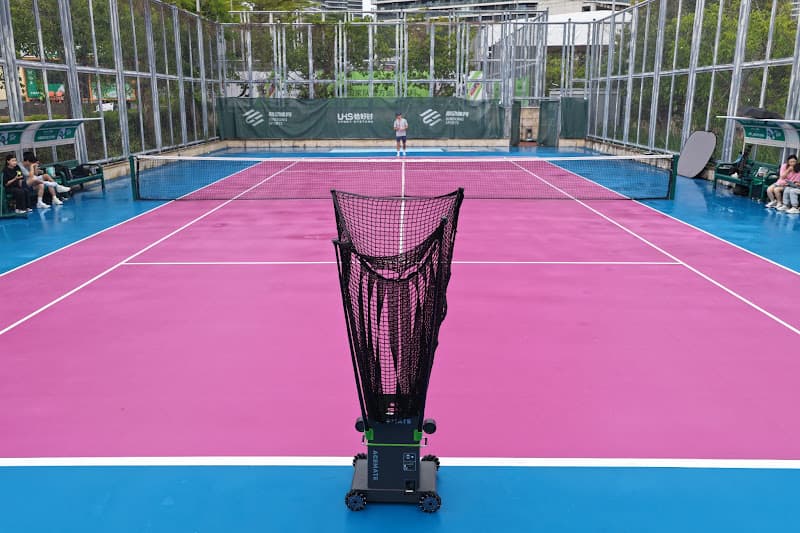
Run the ball machine as one station inside a timed rotation: split the roster into groups of three or four, set up four stations, and move every group on the same signal every 8 to 12 minutes. While one group works the machine, the others run serves, footwork, and net play at the same time. That structure is what turns a single machine into practice for a 16- to 24-player roster instead of a line of kids waiting for a turn. Almost all of the work is organizational and happens before anyone hits a ball: group assignment, station layout, rotation timing, and a defined job for every player who is not currently hitting.
How to Set Up a Tennis Practice Station System
Build the station system from your roster size and court count, then decide what each station trains. Four stations of three or four players each will cover most high school teams and keep the machine from becoming a bottleneck.
Work through it in this order:
- Count your working numbers. Roster size, courts you control, minutes on court after warm-up, machines and hoppers, and how many adults or captains can run a station without you standing there.
- Set the number of stations. Divide the roster by three or four. A 12-player team runs three groups of four or four groups of three. A 24-player team needs six stations, or four stations with two rotations running in parallel on separate courts.
- Assign a job to each station. One is the ball machine. The others should train things that need no feeding: serve targets, footwork and recovery patterns, volley and transition work, or a live-ball point game.
- Fix the rotation order before practice starts. Station 1 to 2 to 3 to 4, always the same direction.
A workable four-station set for a high school team looks like this:
|
Station |
What it trains |
Equipment needed |
|
Ball machine |
Groundstroke repetition, movement patterns, depth control |
Machine, two hoppers, cones or targets |
|
Serve |
Placement to targets, second-serve consistency |
Basket of balls, target cones |
|
Footwork |
Split step, lateral recovery, shadow swings |
Ladder or cones, no balls |
|
Net and transition |
Approach, first volley, overheads |
Coach or captain hand-feeding |
The machine station and the footwork station both run without a coach once the pattern is set, which is the point. Your staffing decides the station count as much as your roster does.
You also do not need a flagship machine to run this. Any ball machine that repeats a pattern reliably will anchor a station, and the ability to oscillate between two targets does more for a rotation than a higher top speed does.
How to Lay Out Stations on Two, Three, or Four Courts
Put the machine on the court you can see from wherever you circulate, and feed it away from adjacent court traffic so stray balls never roll into a live point.
|
Courts and roster |
Layout |
|
2 courts, about 16 players |
Machine on one half of court 1, feeding crosscourt. Serve station on the other half. Court 2 runs live points. Fourth group works footwork off-court behind the fence |
|
3 courts, about 24 players |
Machine at the baseline of court 1. Net and volley station on the far half of court 1. Court 2 for live crosscourt rally, court 3 for serve and return, plus one off-court footwork group |
|
4 courts, about 28 to 30 players |
Machine on court 1, second machine on court 4 if you have one. Doubles positioning, live singles, and serve stations fill the middle courts |
If a machine station and a hand-feed station share one court, feed both toward the same fence rather than at each other, and agree in advance on which side loose balls collect. Stations placed too close together are a common cause of near misses at team practice.
Whether your machine is stationary or mobile changes the layout. A mobile unit can follow the group between courts. A stationary one anchors the rotation, and the groups come to it.
How Many Players Should Be at Each Ball Machine Station?

Three or four players per machine station is the working range for a high school team. Three keeps the ball count per player high, and four gives you enough bodies to cover hitting, shagging, and recovery work at the same time without anyone standing idle.
Two or three players works best for varsity groups and technical work, since each player gets more repetitions and shorter rest. It only works if ball collection keeps up, so plan for a second hopper.
Four players fits most teams. One hits, one is on deck, one shadows or does recovery footwork, one collects. Every job is active, and the rotation inside the station stays quick.
Five or more starts to lose value. The extra players have nothing productive to do, and the group turns into a line. When your roster grows, add another station rather than adding bodies to the machine.
How Long Should Each Station Last?
8 to 12 minutes per station, with 30 to 60 seconds to rotate, works for most high school practices. Shorter blocks spend too much of their time on setup and transitions, and longer blocks lose attention in the back half, which is where technique quietly falls apart.
The math is simple. Four stations at 10 minutes each fill 40 minutes, which leaves a 60-minute practice with 10 minutes for warm-up and 10 for team competition. Transitions come out of the block rather than getting added on top, so plan each station as roughly nine minutes of work plus the switch.
Adjust the length from your total time rather than from a formula. If you only have 30 minutes of station work, run three stations of nine minutes instead of squeezing four in. Cutting a station is better than cutting every station short.
How to Run the Ball Machine Station
Assign every player at the station a job, and rotate jobs every 8 to 12 balls rather than by the clock. That count is short enough to keep quality high and long enough to build a rhythm, and it moves the group along without a coach calling it.
|
Role |
What they do |
|
Hitter |
Takes 8 to 12 balls on the pattern, then rotates out immediately |
|
On deck |
Waits behind the hitter outside the feed path, watches the pattern, steps in on the switch |
|
Shadow |
Mirrors the stroke or runs recovery steps to the center mark behind the baseline |
|
Collector |
Shags from the safe zone and reloads the second hopper |
Players rotate one position after each turn. With four players, 10 balls per turn, and a five-second feed, a 10-minute block gives everyone two or three turns and nobody stands still.
Stick to that cap. Past about a dozen balls in a row, the racket head starts dropping and the feet stop resetting, and the reps begin reinforcing the habits you are trying to fix. That is also the main objection coaches raise about putting a machine in team practice, and rotating roles every few balls is what answers it.
Train your captains before the season rather than during practice. Setup, loading, and a safe pause are most of what a station leader needs to operate a ball machine, and twenty minutes before the first practice covers all three. Inside the block itself, the sequence is the same one a player would follow in a 30-minute solo session: warm-up feeds, technical reps, movement, then something scored.
Five Ball Machine Stations That Work for High School Teams
These five cover the patterns a high school team actually needs, and each one gives the group a way to keep score. Pick two or three per practice rather than cycling all five. There are far more ball machine drills available than a team rotation can use, and the limit is court time, not ideas.
Crosscourt Consistency Station
Feed one deep target to the forehand or backhand corner and have players hit crosscourt. Count consecutive balls landing past the service line. The group's best streak is the station score. It trains the depth and net clearance that hold up under match pressure.
Side-to-Side Movement Station
Set the machine to alternate wide feeds. Players hit, recover to the center mark, then hit the other side. Use a longer gap between balls at first so recovery steps are complete rather than rushed, then tighten it as the group handles it. The difference between fixed feed intervals and recovery-based feeding shows up most in this drill.
Approach and Volley Station
Program a deep ball followed by a short ball. The player drives the deep one, approaches on the short one, and finishes with a volley. This pattern is easy to skip at team practice, because doing it by hand takes a feeder who can put two different depths on the same spot.
Target Accuracy Station
Place cones or towels in the deuce and ad corners and score one point per hit. Groups compare totals across the practice. Targets turn a repetition drill into something players care about, and they give you a number to track week to week.
Pressure Station
Set a bar the group has to clear: land five of eight balls past the service line to finish the set, and start the count over if they miss it. Keep the machine setting identical to the consistency station so the only thing that changes is the consequence.
How to Set Difficulty for JV and Varsity Without Changing the Machine
Keep the machine setting fixed and change the task instead. Resetting speed, spin, and pattern between every group burns transition time and slowly pulls the whole rotation off schedule.
From the same medium-paced deep feed:
|
Same feed, different task |
JV or newer players |
Varsity |
|
Target |
Land the ball anywhere in the opposite half |
Land it deep and crosscourt past the service line |
|
Count |
Reach eight clean contacts |
Reach five in a row before the count resets |
|
Movement |
Recover to the middle after each ball |
Recover to the middle and split step before the next feed |
|
Scoring |
Untimed |
Consecutive-success scoring against the other groups |
When a group genuinely needs a different feed, such as slower balls for beginners at a warm-up station, store both settings in advance so the switch takes seconds. The Acemate S10 carries preset drills in its app and lets you save your own, so a captain can switch patterns from a phone in a few seconds rather than dialing them in while eight players wait. When a roster spans several levels, drills sorted by NTRP rating give each group a starting pattern before you adjust the task on top of it.
For teams that want to build more variety into those rotations, the Acemate S10 Pro extends the same idea across Ball Machine, Drill, Serve, Rally, and Battle modes, with 100+ training options in the app. That gives coaches more ways to assign different groups a specific training objective without rebuilding the session from scratch between rotations.
How to Rotate Players Without Losing Practice Time
Use one signal, one direction, and a fixed 30- to 60-second transition, and have the next group's equipment ready before they arrive. Rotation is where teams lose the most practice time, and almost all of it is recoverable.
- One signal. A whistle or a phone timer on speaker, not a coach shouting from three courts away.
- One direction. Station 1 to 2 to 3 to 4, every time, so nobody has to ask where they are going.
- Pre-loaded hoppers. The collector at each station fills the spare hopper during the block, not during the transition.
- Cones stay put. Set targets once for the whole practice, even if the drill changes.
- Machine settings stay put. Change the task, not the machine.
- Pick up during the transition, not after it. Everyone shags for the first 30 seconds of the switch, including the group that just arrived.
The equipment rules are the ones that save the most time. Every settings reset costs transition time and pushes the whole rotation off schedule, and when a rotation stalls it is usually somebody crouched in front of a machine, not the players.
Example 60-Minute Practice Plan for a High School Tennis Team
Here is a 60-minute practice for a 16-player roster on two courts with one ball machine and one coach.
|
Time |
What happens |
|
0 to 10 min |
Dynamic warm-up and mini-tennis, whole team |
|
10 to 20 min |
Station 1: ball machine, crosscourt consistency |
|
20 to 30 min |
Station 2: serve targets |
|
30 to 40 min |
Station 3: footwork and recovery |
|
40 to 50 min |
Station 4: volley and transition, coach-fed |
|
50 to 60 min |
Team competition, games to 7 or a target challenge |
Four groups of four rotate through all four stations. The coach circulates rather than anchoring one station, spending the most time wherever the strokes look worst that week.
For a 90-minute practice, add a second machine block later in the rotation rather than stretching each station to 15 minutes. Attention drops faster than legs do. Where station days land in the weekly training plan matters as much as the practice design, since a heavy repetition day the afternoon before a dual match leaves legs flat.
How Many Balls and Hoppers Do You Need?
Plan on at least two full hoppers in circulation per machine station. A machine feeding every five seconds empties a 100-ball hopper in a little over eight minutes, which is about one station block, so a single hopper means the station stops right when the group finds its rhythm. Your feed rate setting changes that arithmetic directly, and it is the first thing to check if the station keeps running dry early.
Count only balls that still bounce true. Worn or wet balls feed inconsistently and can jam a feed mechanism, so keep a separate bag of dead balls for footwork and warm-up work. Pressureless practice balls hold their bounce longer than pressurized ones and play slightly heavier, which is the trade-off to settle before a team buys in volume.
Ball-collecting robots change this math without removing it. The Acemate S10 holds 80 balls, and in rally mode it moves to catch returns in its collection net and feeds them back, which stretches the interval between full pickups. Rally mode needs a standard court with clearly visible lines, since the robot uses those lines to locate itself. In ball machine mode it feeds from a fixed position and works on non-standard courts, where rally mode is not available.
Battery Life and Power on School Courts
Check whether one charge covers your full station block, since most high school courts have no accessible outlet. A machine that dies at minute 35 of a 40-minute rotation costs you the last station of the day.
Team use is harder on a battery than solo use, because the machine feeds through every group rather than one player's session. Acemate lists about two hours of run time for the S10 in ball machine mode, measured feeding from the baseline on a hard court, and the battery is user-replaceable, so a charged spare in the equipment bag turns a dead battery into a swap rather than the end of the station. The newer Acemate S10 Pro, currently taking deposits ahead of release, is listed at up to five hours of battery life and a 100-ball capacity, which fits programs running back-to-back JV and varsity sessions on the same afternoon.
Weight matters for the same practical reason. Somebody carries this from a storage room to the courts every day, often a student, so machine weight is a daily constraint rather than a spec-sheet line. Run time, weight, and hopper size are where team use diverges from solo use, and they separate the best tennis ball machines for a program from the ones built around a single player.

Safety Rules for Ball Machine Stations
Set these rules once at the start of the season and enforce them the same way at every practice, since a machine station puts equipment and lightly supervised players on the same court.
- Nobody stands behind or beside the hitter inside the feed path. The on-deck player waits outside it.
- Collectors stay out of the hitting zone until the hitter finishes the turn and steps away.
- Pause the feed before adjusting settings, moving the machine, or reloading.
- Never reach into the launch port or the ball hopper while the machine is powered on, including to clear a jam. Power it off first.
- Stop the station and clear loose balls when the court gets cluttered. A ball underfoot is an easy way to roll an ankle.
- Self-moving robots need clearance. Acemate, for example, asks players to stay at least two meters (about seven feet) from the robot in rally mode and to keep out of its path while it is moving.
- Move indoors or shut it down in bad weather. Damp balls feed unpredictably, and Acemate's manual limits use to an indoor court when it is raining, snowing, or dusty.
Common Station Setup Mistakes to Avoid
Most failed station practices come down to five fixable errors.
Too many players at the machine. Five or six at one station recreates the line you built stations to eliminate. Add a station instead.
Rotations that run too long. Fifteen-minute blocks look efficient on paper and lose the group in the back half.
Changing machine settings every round. Each reset comes out of hitting time and delays every other station.
No job for the waiting players. Any player without a defined role starts talking. Shadow swings and ball collection are jobs.
Identical difficulty for everyone. The same task is too hard for JV and too easy for varsity, and both groups check out for opposite reasons.
Frequently Asked Questions
Is a Ball Machine Worth It for a High School Tennis Team?
It is worth it when your roster outnumbers your courts and coaches, because it adds a station that runs without staffing. It is not a substitute for live hitting or match play, which is where players learn to read an opponent.
Can We Run Station Practice With Only One Court?
Yes. Split the court into three zones: machine feeding crosscourt on one half, serve targets on the other half, and footwork behind the baseline or outside the fence. Shorten stations to about seven minutes so every group cycles through.
Can High School Players Run the Ball Machine Station Without a Coach Watching?
Check your school's supervision policy first, since it usually governs student equipment use. Practically, a trained captain can start, pause, and switch presets safely. Loading, clearing jams, and changing settings should stay a coach's job.
Can We Run a Ball Machine Station Indoors in the Gym?
A standard machine can feed indoors if you have the length, ceiling height, and a safe surface. A low ceiling limits indoor training to flatter feeds, and a busy backdrop makes the ball hard to track.
A Simple Rule for Building Better Practice Stations
A station rotation works when it has small groups, short blocks, a defined role for every player, a way to keep score, and almost no equipment changes between groups. Miss one of those and the practice usually still runs, but the machine goes back to being a line with a hopper next to it.
Build one rotation for your next practice, time the transitions, and note where the balls ran out. Two things usually need adjusting after the first attempt: block length and who is responsible for collecting.
