
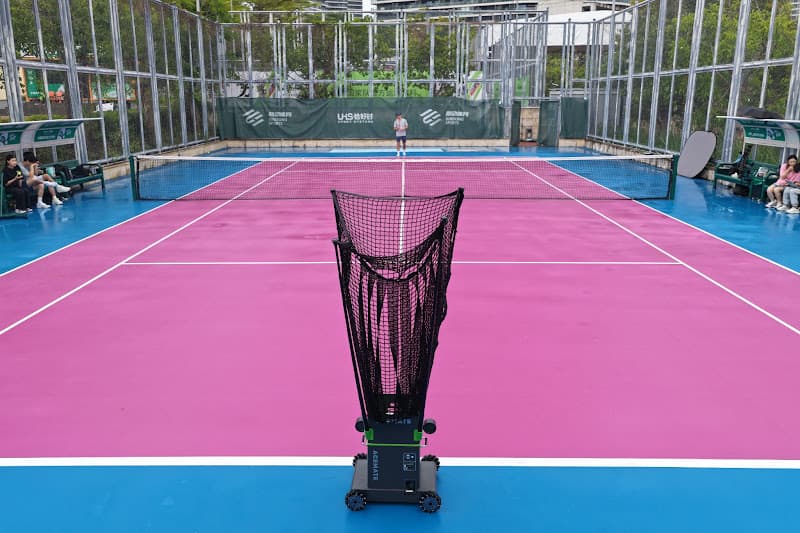
The right drill depends on two things: your level and who you have on court. A 2.5 player and a 4.5 player both need crosscourt repetitions, but the 2.5 needs them from a hand feed inside the service line and the 4.5 needs them at pace with a recovery step. Most drill lists sort by level and stop there. That leaves out the question that actually decides your session: whether you are alone, with one partner, or in a group of six. This guide covers both, with rep counts for each drill and a rule for when to move up.
How to Choose a Drill
Pick the level first, then adjust the drill to the people you have. A drill is defined by what it asks you to do, not by how the ball arrives, so almost every drill here has a solo version, a partner version, and a group version.
|
If you have |
Best drill format |
What to avoid |
|
Nobody |
Wall rallies, self-feeds, serve baskets, or a ball machine |
Trying to practice returns or reactive volleys |
|
One partner |
Crosscourt and down-the-line patterns, figure eight, serve and return games |
Both of you hitting down the middle for an hour |
|
Three to six players |
King of the Court, rotation drills, up-and-back games |
Long lines where each player hits four balls in ten minutes |
|
A coach |
Technical correction and hand-fed repetition |
Using the hour for rallying you could do without them |
Two rules apply at every level. Keep each drill block to 8 to 15 minutes, since attention drops after that and the drill turns into hitting. And set a target for every ball, because a drill without a target measures nothing.
Beginner Tennis Drills
Start with contact before power. At NTRP 1.0 to 2.5 the goal is meeting the ball cleanly in front of you often enough to build a rally, and every drill below serves that.
Drop and hit, 20 balls per side. Drop a ball beside you, let it bounce to waist height, and hit it over the net. No footwork, no target beyond depth. This is the fastest way to find your contact point, and it is the drill most beginners skip because it looks too easy.
Mini-tennis, 5 minutes. Rally inside the service boxes with a partner, or against a wall from close range. Short court forces you to control the racquet face instead of swinging hard, and it builds a rally faster than baseline hitting.
Doubles alley targets, 20 balls. Aim into the alley on your forehand side, then the backhand side. Direction control comes before pace, and the alley is a target narrow enough to mean something.
Serve toss, 20 tosses, no hitting. Stand at the baseline and toss to the same spot 20 times, catching each one. The toss is the part of the serve you can fix without a coach, and it is worth its own block.
Clean contact is also what makes the early stage feel less discouraging, and it is most of what makes tennis hard to learn at the beginning.

Intermediate Tennis Drills
Add movement and direction. At 3.0 to 3.5 the strokes exist, and the gap is hitting them on the run and putting them somewhere specific.
Crosscourt consistency, 10 in a row. Rally crosscourt with a partner and count consecutive balls in the court. Reset the count on any error. Ten in a row is a real target at this level and it exposes whether your depth holds up under mild pressure.
Two-line movement, 20 balls. Alternate forehand and backhand corners with a recovery step to the center mark between every ball. Touch a cone on the center mark to keep yourself honest, since the recovery is the part that quietly disappears.
Figure eight, 4 minutes. One player hits every ball crosscourt while the other hits every ball down the line, then switch. It trains direction control and gives both players continuous movement.
Short ball and approach, 10 balls. Have a partner feed a ball near the service line, drive it down the line, and finish the point at the net. The transition ball is where a lot of intermediate points are lost.
Serve plus one, 10 serves. Serve, then play the next ball to a target. Practicing the serve alone leaves out the shot that follows it, and the two work as one pattern.
Backhands often lag at this stage, and a dedicated block helps more than mixed rallying. The same is true of movement, since footwork is often the limiter at 3.0 rather than swing shape. There are specific backhand practice methods worth running as their own block.

Advanced Tennis Drills
At 4.0 and above, technique is largely settled, so practice has to reproduce decisions, fatigue, and score rather than swing shape.
Return plus one, 20 returns. Have a partner serve, return deep to a target, then play the next ball out. The return is the hardest shot to drill without a partner, so it belongs in every session where you have one.
Defense to offense, 12 balls. Take three deep balls in a row that push you behind the baseline, then attack the fourth. The skill is recognizing the ball that lets you change roles, which is a decision drill rather than a stroke drill.
Serve plus one to a pattern, 20 serves. Serve wide, then hit the next ball to the open court. Serve into the body, then take the middle. Score it out of 20 rather than hitting freely.
Point play from a neutral feed, 10 points. Start every point with a feed to the middle and play it out. This removes the serve advantage and forces both players to construct.
At this level the useful variable is pace and pattern rather than repetition count, so working at match pace matters more than adding balls.
Drills for Practicing Alone
Solo practice covers groundstrokes, serve, and movement. Returns and reactive volleys are the hardest to cover alone, since both need a ball you did not schedule.
The wall, 10 minutes. A wall gives you more repetitions per minute than almost anything else on court. It is unforgiving on timing, which is exactly why it works. Comparing a wall, a rebounder, and a ball machine mostly comes down to how much control you want over the incoming ball.
Serve baskets, 50 to 60 balls. Two targets per box, counted in sets of ten. Serving is the one stroke you can practice in its match form with nobody else on court, and a short set of serve accuracy drills beats hitting a basket without aiming.
Shadow swings and footwork ladders, 5 minutes. No ball. Useful for grooving a change without the pressure of contact.
Ball machine blocks, one hopper. A tennis ball machine is the solo option that lets you fix pace, spin, and landing zone before you hit, which is what makes structured solo drilling possible. The Acemate S10 feeds each shot with its own direction, speed on a 1 to 10 dial, spin, and elevation, and its rally mode returns the ball on a standard court, so the reply comes back and you have to play it. A hopper holds 80 balls, which is one full session block. The drill side of it is covered in a fuller set of ball machine drills.
For players who want to move beyond fixed-feed repetition, the Acemate S10 Pro extends that idea into a broader training session. Its Rally, Drill, Serve, Ball Machine, and Battle modes let you move from controlled repetitions into footwork, multi-ball patterns, serve-plus-one work, and more match-like exchanges, while its training data can be used to review placement, speed, accuracy, and other session metrics.
More options for structuring a session without a partner sit in the guide to practicing tennis alone.

Drills for Two Players
With one partner, the mistake is rallying instead of drilling. Assign roles and keep score.
Cooperative crosscourt, count to 10. Both players hit crosscourt only, counting consecutive balls. It looks simple and it exposes depth immediately.
One up, one back, 5 minutes. One player at the net, one at the baseline, continuous play. Switch after five minutes. Trains volleys and passing shots at the same time.
Serve and return games, 20 points. Server gets one serve, returner must land the return past the service line. Score it. Removing the second serve makes both players play the percentages.
Half-court singles, 11 points. Play out points using only one half of the court lengthwise. It forces patience and direction, and it doubles as conditioning.
Drills for Groups
Group drills live or die on ball count per player. Aim for at least 15 balls each per ten minutes. Below that, the format has become a line rather than a drill.
King of the Court, 15 minutes. One player holds the far side and defends it against a line of challengers, one point at a time, and the winner stays. It works with any number from three up, needs no coach, and the queue gives everyone rest between points.
Two-ball rotation, 10 minutes. Two balls in play on the same court with four players, rotating after each point. It doubles the ball count and forces awareness.
Up and back rotation, 8 minutes. Two players at the net, two at the baseline, rotating positions every two points, so everyone gets both roles.
Target games, 11 points. Place four cones and play a game where hitting a cone is worth a point. Groups drill harder when the drill is scored.
How to Build a Practice Session
Order the session so that the hardest thinking happens while you are fresh. A 90-minute session divides cleanly into five blocks.
- Warm-up, 10 to 15 minutes. Movement, short court, gradually deeper.
- Technical block, 15 minutes. One stroke, repeated feeds, one thing to watch.
- Pattern block, 15 minutes. Two or three shot sequences with targets.
- Competitive block, 20 minutes. Points, games, or King of the Court.
- Serve block, 15 minutes. Last, when your legs are tired, which is when you serve in a third set.
Blocks two and three differ in kind, not only in content. The technical block repeats one shot so you can change something about it, and the pattern block mixes shots so you have to recognize the ball before you swing. Splitting a session between blocked and random practice is what makes the repetitions hold up in a match rather than only on the practice court.
Two sessions of this shape do more than one long one, which is the reasoning behind building a weekly training plan rather than a single weekly marathon.
How to Know When to Move Up
Use a hit rate against a target, not a feeling. Each drill above has a natural gate, and these three cover most of them.
- Ten consecutive crosscourt balls in the court before adding pace or moving the target to a corner.
- Seven of ten balls into a three-foot by five-foot corner zone before shortening the interval or the recovery time.
- Winning three points in a row in a competitive drill before moving to a stronger group.
If a number stalls for three or four sessions, the drill is usually too hard rather than wrong. Cut one variable, whether that is pace, spin, target size, or movement distance, and rebuild. Spin is the one most players overlook, since spin changes the bounce more than pace does.
Tracking ball placement across sessions makes a stall visible before it turns into a plateau. What counts as progress also shifts as you improve, which is how training needs change from beginner to advanced.
Frequently Asked Questions
What Is the Difference Between Drilling and Playing Points?
Drilling repeats a situation until you can execute it. Playing points tests whether you choose it under pressure. Improvement needs both, and most recreational players get plenty of the second and almost none of the first.
How Many Times a Week Should I Drill?
Two drill sessions a week alongside match play is enough for most recreational players. Frequency beats duration, since a skill practiced twice for 45 minutes tends to hold better than the same 90 minutes in one block.
Do Kids Need Different Tennis Drills?
Younger players need shorter blocks, smaller courts, and low-compression balls, but the drill logic is the same. Cut every block to five minutes and score everything, since scoring tends to hold attention better than instruction does.
Can I Run These Drills Without a Coach?
Yes, with one caveat. Drills build patterns, but they do not tell you whether your technique is sound, so film yourself now and then, or book a lesson every few months. The same limit applies to machine practice, which is covered in whether a ball machine can replace a coach.
How Do I Keep Track of Drills on Court?
Write the session on an index card: drill name, ball count, and target for each block. A card in your bag beats a printable sheet, because you can update it between sessions while a printout goes stale after the first progression.
