
A Week on Court in Florida
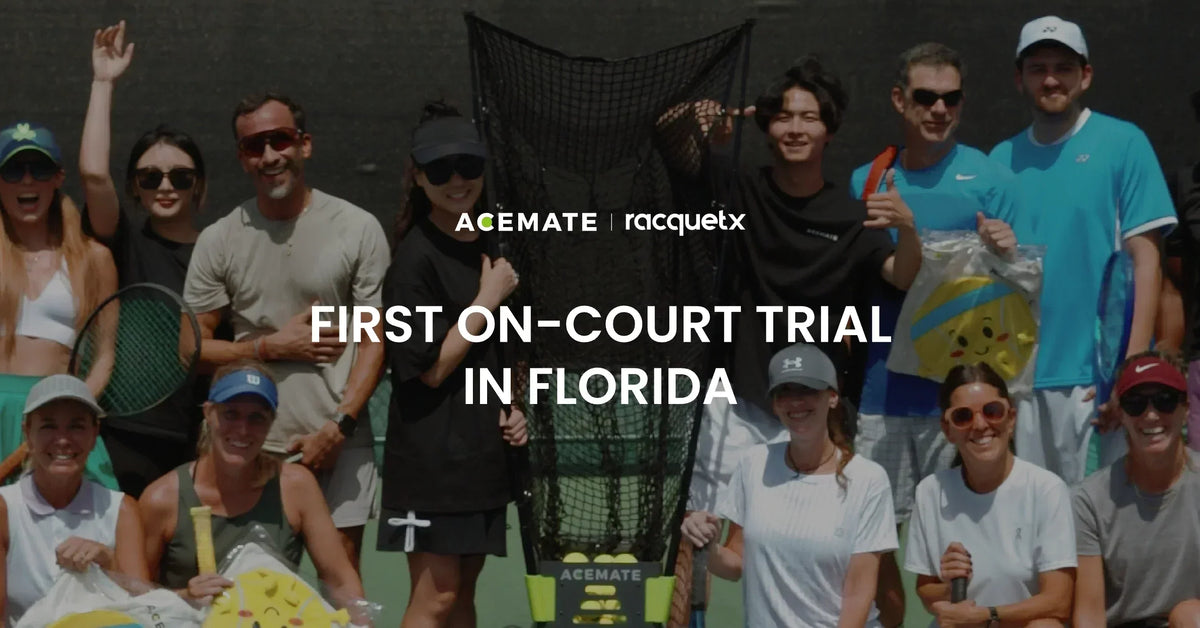
Last month, we brought Acemate, our next-generation tennis robot, to Florida for the first time—starting with RacquetX, followed by a small, invite-only demo day at the Turnberry Marina courts.
It was a week that gave us something simple but important: real players, real courts, and real reactions. For a product built to transform solo tennis practice into something closer to real play, there’s no better test than letting people step on court and experience it themselves.
RacquetX: Curiosity, Crowds, and First Hits
RacquetX brought together players, coaches, and tennis enthusiasts from across the community. From the start, there was a steady flow of people stopping by—some curious, some skeptical, most just wanting to see what an AI-powered tennis robot actually feels like on court.
At a glance, many assumed it was just another tennis ball machine. But that perception usually changed quickly. Once players stepped in and started hitting, the difference became clear: instead of feeding balls in a fixed rhythm like a ball machine, the rally continued. Shots came back with variation—depth, pace, placement—forcing players to adjust, recover, and stay engaged in the point.
It wasn’t just repetition. It was interaction. That’s when the idea of a true tennis ball machine alternative started to click.
“It Feels Like Playing a Real Person”
Across the three days, one type of feedback came up repeatedly—and almost always in the same words:
“It feels like I’m rallying with a real person.”
Players didn’t just notice the difference—they felt it. Timing wasn’t robotic. Rhythm wasn’t predictable. Each rally required attention.
Some came expecting a quick demo and ended up staying longer than planned. Others walked off the court and said:
“This is way more realistic than a ball machine.” “It actually helps you stay focused like in a match.”
Beyond realism, another theme emerged: consistency. Because the tennis robot could return balls with stable yet dynamic variation, players stayed in rallies longer—and that repetition helped them build rhythm and shot consistency much faster than traditional drills. Not just hitting more balls—but hitting better, more connected sequences.
From Expo Floor to Real Courts
After RacquetX, we moved into a more focused setting: a private demo day at Turnberry Marina. With fewer people and more time on court, the experience naturally went deeper. Players explored different rally setups—adjusting speed, height, and placement—while seeing how the tennis robot responded in real time. Sessions became more fluid and continuous, unlike the short, fixed interactions typical of a tennis ball machine.
Open courts, warm Florida weather, and a relaxed pace gave players space to settle in and actually play.

From First Hit to Finding Rhythm
The first few shots were cautious—testing timing, reading the ball. But within minutes, footwork became more natural, swings loosened, and players started anticipating instead of reacting late. Extended rallies built up, allowing players to stay in rhythm—adjusting, recovering, and repeating.
Several players commented:
“This is the first time solo practice actually feels like real practice.” “You can really lock into a rhythm.”
That ability to sustain a rally is what separates a tennis robot from a traditional tennis ball machine—and what makes AI tennis training fundamentally different.

A Different Kind of Solo Practice
For many players, solo practice has trade-offs. A tennis ball machine is great for repetition but often lacks variation and realism. Practicing with a partner or coach is ideal—but not always accessible.
What we saw in Florida reinforced something important: when solo practice becomes more interactive, it becomes more effective. A tennis robot that can track, respond, and return balls in a rally format allows players to train not just strokes, but timing, movement, and consistency—all within a more game-like environment. Most importantly, it keeps players engaged longer.

A Team Moment
Our team got up early, setting up courts and checking systems to make sure everything ran smoothly. Between sessions, Tony and Fenny spent time chatting with players—answering questions and hearing their first impressions.
We also gave every attendee a branded tote as a small thank-you. Whether trying Acemate for the first time or already using it in training, everyone genuinely enjoyed the experience. Seeing their excitement and hearing their honest feedback showed us how much people connect with Acemate—and with the care our team puts into creating the experience.


What We Took Away
Florida wasn’t just about showing the product—it was about understanding how it fits into real training environments. Curiosity turned into engagement, skepticism into surprise. Most importantly, players stayed in rallies longer than expected—building consistency naturally. From hitting balls → to playing points. From repetition → to rhythm.
