
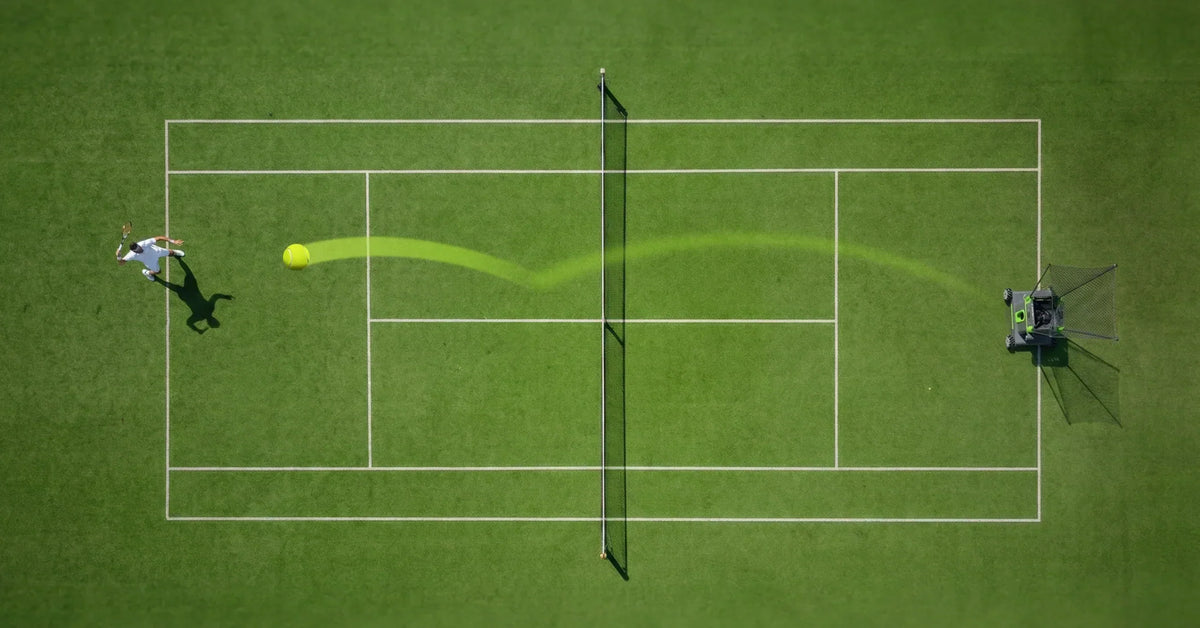
Rethinking What Solo Practice Should Feel Like
Solo tennis training has traditionally focused on repetition. A player hits balls launched at fixed intervals by a traditional tennis ball machine, resets after each cycle, and repeats the same movement pattern. While this method helps build stroke consistency, it does not replicate the rhythm, adaptation, or sustained decision-making required in real match play.
The limitation is not the absence of effort, but the lack of interaction. Without responsive feedback, training remains mechanical rather than dynamic.
AI-driven ball trajectory technology changes this foundation by transforming solo drills into continuous exchanges—evolving the role of the tennis ball machine from a simple feeder into an intelligent rally system.
From Static Ball Feeding to Adaptive Trajectory Response
Instead of simply launching balls according to pre-set programs, the system upgrades the conventional tennis ball machine concept by using computer vision to analyze each incoming ball in real time. By tracking trajectory data—including speed, direction, height, and spin—the AI determines how to return the ball in a way that sustains rally continuity.
This trajectory-based intelligence is what fundamentally improves solo practice. Because the system responds to live ball behavior rather than a fixed sequence, each return is shaped by the previous shot. Training becomes an evolving interaction rather than a repetitive loop.
Players can still configure parameters such as court position, ball speed, launch height, and spin settings. However, once the rally begins, the system shifts from preset mode to adaptive mode—continuously adjusting its response based on incoming trajectories. This creates uninterrupted back-and-forth play without manual resetting, redefining what a tennis ball machine can achieve.
How Continuous Trajectories Improve Training Quality
The key improvement comes from continuity. Traditional tennis ball machines interrupt practice between cycles, which breaks rhythm and reduces match realism. AI-driven trajectory tracking maintains ongoing rallies, allowing players to experience sustained exchanges similar to competition.
This continuous structure improves solo practice in several ways:
First, it enhances reaction time. Because the machine responds dynamically to each trajectory, players must adjust to varying return angles and speeds in real time.
Second, it strengthens movement efficiency. Sustained rallies require constant positioning and recovery, encouraging better footwork patterns.
Third, it improves shot selection. With extended exchanges, players learn to make strategic decisions under ongoing pressure rather than isolated repetition.
Finally, it builds endurance within realistic rally conditions. Instead of short bursts separated by resets, training sessions become longer, flow-based interactions that more closely resemble match intensity.
Together, these improvements shift the tennis ball machine from a mechanical launcher to an intelligent training partner.
Creating Match-Like Rhythm Without a Partner
One of the biggest challenges in solo training is reproducing match rhythm without a hitting partner. AI-driven ball trajectory systems solve this by maintaining real-time exchange through an adaptive tennis ball machine framework.
Because the system analyzes and adapts to each shot’s trajectory, it can sustain continuous rallies that simulate the timing and variability of competitive play. This allows athletes to train independently while still experiencing structured interaction.
For players who do not always have access to a partner, this capability significantly increases the quality and realism of practice sessions.

Redefining the Role of Training Equipment
Traditional tennis ball machines function primarily as mechanical launchers. AI-driven trajectory systems redefine this role. Rather than delivering pre-programmed sequences, the equipment becomes part of a responsive feedback loop—observing, interpreting, and reacting in real time.
This transition reflects a broader evolution in training technology: from static automation to intelligent interaction.
As computer vision and robotics continue to advance, the tennis ball machine is no longer just a feeding device—it becomes an adaptive system capable of simulating real gameplay dynamics.
The Result: More Effective Solo Training
By transforming ball delivery into trajectory-aware response, AI-driven systems fundamentally improve solo tennis practice. Training becomes continuous, adaptive, and rhythm-based. Players experience longer rallies, higher engagement, and more realistic pressure conditions.
Instead of practicing isolated strokes with a conventional tennis ball machine, athletes train within sustained exchanges that mirror match demands.
In this way, AI-driven ball trajectory technology does not simply automate practice—it upgrades the tennis ball machine into an intelligent, performance-oriented training system designed for modern solo players.
