
For recreational players who practice alone regularly, an AI tennis ball machine is generally worth it: the ball stops arriving the same way every time, so the session trains movement and recovery instead of only technique. If you mainly need stroke repetition, a traditional machine does that for several hundred dollars less. US ball machines span roughly $300 to $3,000, and how much the AI premium costs depends on which of three capabilities you are buying, since only one of them changes what happens during a session.
What "AI" Means on a Tennis Ball Machine
On an AI-powered tennis ball machine, the label refers to one of three capabilities: an app that runs saved drill sequences, sensors that track the ball and report data afterward, or a system that senses and responds while you are hitting.
Level 1: Programmed Drills
The machine stores shot sequences you built in an app and plays them back, which gives you drill variety and repeatable patterns. Nothing is sensed. At this level the AI label describes the app, not the machine's behavior on court, and a good non-AI programmable machine has done the same thing for years.
Level 2: Sensing and Analytics
Cameras or sensors follow the ball and log what happened: shot count, speeds, net clearance, landing points, and how many balls stayed in. The feed does not change, since the machine still fires pre-set shots from a fixed position. You get a record to review afterward.
Level 3: Sensing and On-Court Response
The machine tracks the ball and reacts physically by moving, catching, or changing the return, so the shot comes back from a different place each time. Machines at this level are often sold as tennis robots rather than ball machines, which is a useful signal when comparing product pages. It is the level that turns a feed into a rally, and the shift from feeding balls to rallying back is recent enough that few models have made it.

What an AI Tennis Ball Machine Changes on Court
It changes where the ball comes from, who sets the rhythm, how you review a session, and in a few cases how often you stop to collect balls.
Placement you cannot read. A fixed feeder repeats a pattern you learn to anticipate quickly. Sensing machines break that pattern in different ways: some vary pace, spin, and depth from a fixed position, while others change where the ball is played from.
Rhythm outside your control. Some machines hold the next ball until you have recovered toward the center of the baseline, which forces the step recreational players skip. Machines that move and return the ball create the same demand differently, since the return leaves from wherever the machine went to reach your shot. Around the NTRP 3.5 to 4.25 level, footwork and reaction time rather than technique tend to be the limiting factors, and this is the practice that reaches them.
Sessions you can compare. Machines that sense the ball log what happened during a session, so one week can be measured against the next instead of remembered. Which figures you get varies by model, though shot count, speed, and where balls landed are common. The numbers are only as informative as the ball trajectories behind them.
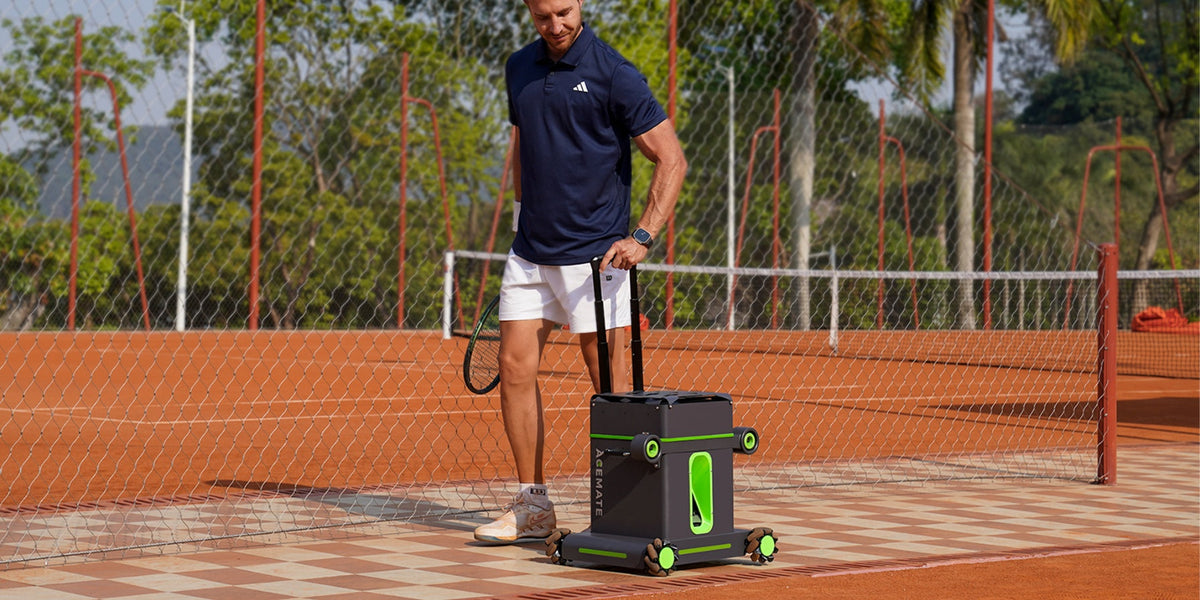
Ball collection, in a few cases. Tracking where a ball lands is a different problem from retrieving it, so most AI machines still leave you collecting the balls you hit. A small number solve it physically. The Acemate Tennis Robot S10 is one: in rally mode on a standard court, a 4K binocular camera system tracks your shot and predicts the bounce point, the robot responds in about 0.15 seconds and drives there on four Mecanum wheels at up to 16 feet per second, catches the ball in an adjustable net that rises to about 5 feet 7 inches, and returns it at speeds up to 60 mph. Balls it catches drop back into the 80-ball hopper, so play runs longer between pickups, and the return leaves from wherever the robot moved to make the catch, which builds recovery into the exchange.

How Much More an AI Machine Costs
Machines marketed as AI generally start around $900 and reach $3,000 or more, against roughly $300 to $1,300 for traditional programmable machines. The premium varies because the three capability levels carry different prices.
|
Traditional programmable |
Sensing and analytics |
Tennis robot (senses and responds) |
|
|
Typical US price |
$300 to $1,300 |
$900 to $2,000 |
$2,000 to $3,000+ |
|
Control |
Dials or app |
App, plus session reports |
App, plus reaction during play |
|
Awareness of the ball |
None |
Tracks and logs it |
Tracks and responds to it |
|
Where the ball comes from |
One fixed point |
One fixed point |
Wherever the machine moved |
Much of the market's practical capability sits between $700 and $1,300, where app programming, adjustable spin, and dependable build quality overlap. Paying above that band buys sensing and physical response rather than better feeding, which is why comparing headline prices across the three levels gives a misleading picture.
Against coaching, a machine adds no hourly fee of its own once bought, while lessons are billed by the hour. The two cover different needs, since a machine supplies volume and a coach supplies correction.
When It Is Worth It for a Recreational Player
It is worth it when you practice alone at least weekly, your strokes already hold up, and the points you lose come from positioning rather than technique.
- Frequency. The capability you paid for only exists while you are hitting, so how often you practice and what kind of practice works decides more than any specification. Training alone once or twice a week returns the cost quickly; playing mostly social doubles does not.
- Level. Below roughly NTRP 3.0, useful practice is predictable repetition, which most machines deliver. From 3.0 upward, movement and recovery become the limiting factors, and a ball arriving from a different place each time is what trains them.
- Court cost. Where you pay by the hour, minutes spent collecting balls are minutes you already bought.
If all three describe you, the premium is straightforward. If only one does, waiting a season before buying is reasonable.
When a Traditional Machine Is Enough
A traditional machine is enough when your bottleneck is repetition rather than variability.
Players with regular hitting partners already get variability from matches. What they lack is controlled repetition, and a fixed feeder supplies that more precisely than a machine that rallies back. Players training for fitness and hitting volume need capacity and reliability, and response or analytics go unused.
Frequency decides more here than budget. A machine used weekly earns its price at almost any tier; one used monthly stays expensive per session whatever it cost.
Frequently Asked Questions
Which AI Tennis Ball Machine Is Best for a Recreational Player?
The right machine depends on which capability level you need, since these machines differ more in what they do than in what they cost. Decide first whether you want programmed drills, session analytics, or on-court response, then compare only machines at that level. Judging an app-controlled feeder against a machine that moves and returns balls on price alone produces a misleading result.
Do You Still Have to Pick Up the Balls With an AI Ball Machine?
With most of them, yes. Sensing and retrieving are separate problems, and the majority of AI machines only solve the first. The exceptions are machines built to catch or gather balls physically, which cut how often a session stops. If collection is what limits your practice, look for that capability specifically rather than for AI features in general.
Are Tennis Ball Machines Worth It at All?
For anyone practicing alone at least a few times a month, generally yes. A machine gives you repetition on demand without depending on a partner's schedule, and the cost per session falls with every use. Below that frequency, most machines end up stored rather than used.
Does AI Actually Improve Your Tennis, or Is It Marketing?
It depends on which capability you buy. On-court responsiveness changes what a session trains, because movement and recovery only get practiced when the ball arrives from somewhere new. Analytics help players who review them and adjust. Programmed drill sequences labeled as AI change little, since a good non-AI programmable machine already does that.
