
Published runtimes for battery-powered tennis ball machines span roughly 2 to 8 hours per charge, and the spread comes from what the machine is doing rather than from how good the battery is. Runtime is stored energy divided by average power draw, so a machine feeding one ball every ten seconds and a machine that drives around the court to chase balls can carry identical packs and produce wildly different numbers. Everything below follows that equation: what drains the battery, how to compare what is stored, how long it takes to put back, and what keeps the pack healthy across seasons.
How Long Do Battery-Powered Tennis Ball Machines Run?
Two to three hours is the realistic figure for most machines under normal use, with lightweight and entry models often quoted near 4 hours and large club machines quoted as high as 8.
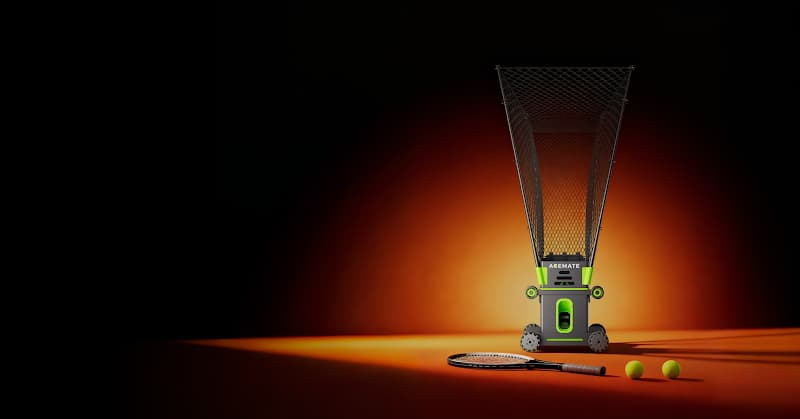
Those higher numbers are usually measured at the lightest possible workload: slow ball speeds, long feed intervals, no oscillation, and no onboard tracking. Published figures across current ball machines rarely state which of those conditions applied. The Acemate S10 publishes two figures with the test conditions attached, which is the format worth looking for: about 2 hours in ball machine mode, measured feeding from the baseline on a hard court, and about 1.5 hours in rally mode, measured in cycles of 10 minutes of continuous rally play followed by 5 minutes of ball collection. The second number is lower because the robot moves the entire time.
The newer Acemate S10 Pro shows the same workload effect at a different scale. Its published runtime is up to 5 hours in Serve and Ball Machine modes and up to 3 hours in Rally, Drill, and Battle modes. That gap matters more than the headline number: stationary feeding and serve practice place a different load on the battery than training modes that combine ball tracking, movement, and repeated on-court responses.
Hours are the wrong unit anyway. Convert to sessions. An 80-ball hopper at an 8-second interval empties in about 11 minutes, so two hours of feeding runtime covers roughly 11 hopper loads, and the four or five minutes you spend collecting after each load are minutes the launch motors sit idle. That is a much longer session than two hours on the clock. Drop to a 3-second interval and the same battery is gone far sooner.
What Actually Drains the Battery
Average power draw is what sets runtime, and it is dominated by how often the launch motors have to work rather than by how hard they work once.
A ball machine load is bursty. The launch wheels draw a spike at startup and again each time they recover speed after a ball passes through them, then sit near idle until the next ball. The arithmetic is easy to run: a 12 V, 12 Ah sealed lead-acid pack holds 144 Wh, and a machine that empties it in about two hours at full power is averaging roughly 72 watts. The instantaneous draw during a launch is many times that. Average and peak are two different specifications, and both matter.
Four things raise the average:
- Feed interval. The single largest lever. Halving the interval roughly doubles the number of motor events per hour.
- Ball speed and spin. Faster wheels and heavier spin mean more work per ball and a longer recovery back to speed.
- Oscillation and movement. Positioning motors, and on self-driving machines the drive motors, run whether or not a ball is being fed.
- Onboard sensing. Cameras, processors, and tracking add a small continuous draw that never stops during a session.
This is why a runtime claim without stated conditions tells you almost nothing. When conditions are missing, assume the number describes the lightest duty cycle the machine supports.

How to Compare Battery Specs Between Machines
Compare watt-hours, never amp-hours, and check that the pack can also deliver the motor's peak current.
Watt-hours are volts times amp-hours. A 12 V, 18 Ah lead-acid pack holds 216 Wh. A 24 V, 10 Ah pack holds 240 Wh. A 36 V, 6.7 Ah pack holds 241.2 Wh, which is the Acemate S10 figure. The middle and last packs store nearly identical energy while their amp-hour ratings differ by 50 percent, so any listing that quotes amp-hours without voltage is not comparable to anything. Find the voltage first.
The second requirement gets overlooked. A pack has to supply the launch motors' startup and recovery current, not just the session's total energy. Lead-acid handles short high-current demands naturally, which is one reason older designs use it. A lithium pack has to do it through a battery management system, and a BMS with a conservative current limit will cut power under a load the cells themselves could supply. Rated continuous and peak current belong next to watt-hours when a pack is being evaluated or replaced.
Usable energy is a third figure, and it is lower than rated energy for lead-acid. Rated amp-hours are measured over a long, slow discharge; pull harder and you get less out. Voltage also sags as a lead-acid pack empties, which can soften ball speed near the end of a session before the machine actually stops.
Lead-Acid or Lithium: What the Choice Changes
Weight, charging time, and storage routine, in that order of practical impact.
A common 12 V, 18 Ah sealed lead-acid pack weighs around 13 pounds. A lithium pack of comparable capacity in a similar enclosure comes in near 5.5 pounds. On a 40 to 50 pound machine, that swap removes close to 8 pounds, or roughly 15 percent of the total, which is the difference between a machine you lift into a trunk willingly and one you leave at home. This is the main reason machine weight and battery chemistry are the same conversation.
Lead-acid persists because it is cheap, standardized, easy to source locally, and untroubled by high startup currents. Lithium wins when the machine has to be carried, when charging turnaround matters, or when the design is built around a swappable pack. The S10 uses a rechargeable lithium-ion pack, and the pack is removable rather than sealed in.
One warning if you are considering a chemistry swap on an older machine: matching voltage and case size does not make a battery a drop-in. The charger profile, the BMS current limits, the fuse rating, and the machine's own battery gauge all have to agree with the new pack. A lead-acid charger's float and maintenance behavior is not designed for a lithium BMS.
How Long It Takes to Charge
Divide the pack's watt-hours by the charger's watts for a floor, then add time for the taper at the top of the range.
The S10 charger is rated 42.0 V DC at 3.0 A, or 126 W, and accepts 100 to 240 V AC at 50 or 60 Hz. Against the 241.2 Wh pack, that is about 1.9 hours of pure charging, so a full charge lands near two hours. Real charge time always runs past the raw arithmetic because current tapers as the pack fills, which is normal behavior and not a fault.
Chemistry changes this answer more than any other factor. Modern lithium packs commonly recharge in one to five hours. Lead-acid does not: some manufacturers of lead-acid ball machine batteries call for periodic charges of 14 to 16 hours to reach full saturation, which is a different maintenance job from an overnight charge. Blanket claims that "batteries charge in a few hours" are describing lithium only.
Two practical rules apply whatever the chemistry. Charge indoors at room temperature, and let a pack that has been sitting in a hot trunk cool before it goes on the charger. And use the charger the machine came with, since charge profiles are chemistry-specific. For what your charging indicator lights mean, check the user guide rather than reading the colors.
Battery Care Depends on Chemistry
The correct storage state is opposite for the two chemistries, and getting it backward is an easy way to shorten a pack's life.
|
Sealed lead-acid |
Lithium |
|
|
Store at |
Full charge, always |
Partial charge, not full and not empty |
|
After a session |
Recharge promptly |
Recharge before the next session |
|
Deep discharge |
Never; causes permanent damage |
Avoid; less punishing but still ages the pack |
|
Long storage |
A topping charge every 3 to 6 months, or leave it on a smart charger |
Check the level every few months |
|
Overcharging |
Real risk with a basic constant-current charger |
Follow the manufacturer's instruction |
|
Heat |
Shortens life |
The main aging factor |
Store a lead-acid pack empty and it will not fully recover. Store a lithium pack at 100 percent for a whole winter and you lose capacity you never get back. Advice that merges the two, which is common, is wrong for one of them.
Acemate's own instruction for the S10 is to charge it fully before the first use and to avoid both overcharging and complete depletion, and to check battery level and charging status periodically. The machine is rated to operate between 32 and 104 degrees Fahrenheit. That is an operating spec rather than a storage spec, but a car trunk in summer sits above it either way, which is reason enough to bring the pack indoors. Broader maintenance routines cover the rest of the machine on the same schedule.

How Long a Ball Machine Battery Lasts, and When to Replace It
Two to five years is the range commonly quoted across the category, and where a specific pack lands inside it is influenced more by storage habits than by hours of use.
The replacement signal is a runtime drop measured under controlled conditions. Compare like with like: same mode, same feed interval, similar temperature. A shorter interval, colder weather, or a switch from stationary feeding to a mode where the machine moves will all cut runtime with nothing wrong. If a pack that used to cover a full session now dies halfway through with none of those changed, it has aged out. Sudden shutdowns at moderate charge levels point the same direction.
Before condemning a pack, rule out the cheap causes. For the S10, Acemate lists three causes to check when the machine will not power on: the battery is too low, the ambient temperature is outside the 32 to 104 degree range, or the power switch has not fully engaged and has sprung back. The S10's pack is user-replaceable and lives on the lower right of the back panel; the swap is open the cover, disconnect the DC cable, pull the old pack, seat the new one, reconnect, and close up. Acemate sells a spare battery separately, and the higher-specification S10 bundle includes one.
Flying and Shipping With a Ball Machine Battery
Ball machine batteries are too large to fly on a passenger aircraft, and the cutoff is a watt-hour number printed on the pack.
The FAA sets three tiers for rechargeable lithium-ion batteries. Up to 100 Wh is allowed in carry-on. From 101 to 160 Wh requires airline approval and is limited to two spares per passenger. Above 160 Wh is forbidden from passenger aircraft entirely, in carry-on and checked baggage alike. Spare batteries must always be carried on and can never be checked.
Every pack discussed here is above that ceiling. The S10's 241.2 Wh pack is about one and a half times the limit, and the 216 Wh and 240 Wh packs used elsewhere in the category are in the same position. This is a rule about watt-hours, not a property of any particular machine.
Ground shipping is the alternative, and it has its own rules. Lithium-ion batteries must pass UN 38.3 transport testing, which the S10 battery has, and standalone lithium-ion batteries shipped by air travel as UN 3480 with a state-of-charge cap of 30 percent under current IATA guidance. In practice this means a pack shipped separately will arrive nearly empty by design, so plan on charging it before the first session rather than expecting to play the day it lands.
Frequently Asked Questions
Does Cold Weather Affect Ball Machine Battery Runtime?
Yes. Lithium and lead-acid both deliver less usable energy in the cold, so a pack that covers a full session in July can fall short in January. The Acemate S10 is rated to operate between 32 and 104 degrees Fahrenheit, and below freezing you are outside the specified range rather than simply losing runtime.
Can a Battery-Powered Ball Machine Run on AC Power?
It depends on the machine. Some models can run plugged in, others use the AC connection only to charge the pack, and a few sell a mains module as an accessory. Check the spec before planning around it, and note that most public courts have no outlet within reach anyway.
Is a Lithium Battery Worth the Extra Cost Over Lead-Acid?
Usually yes if you carry the machine, and it matters much less if you do not. The weight saving on a comparable pack is roughly 8 pounds, charging turnaround is far shorter, and storage is more forgiving, though it lands at the higher end of machine prices. For a machine that lives at a club and charges overnight, lead-acid still does the job at lower cost.
Do I Need a Spare Battery?
Only if your sessions regularly outlast one charge, or if recharging between sessions costs you court time. Coaches running back-to-back lessons and clubs sharing one machine benefit most. For a player doing one session at a time with the machine going home afterward, one pack is usually enough. Whether the pack is swappable at all is worth checking when comparing machines, since a sealed battery removes the option entirely.
