
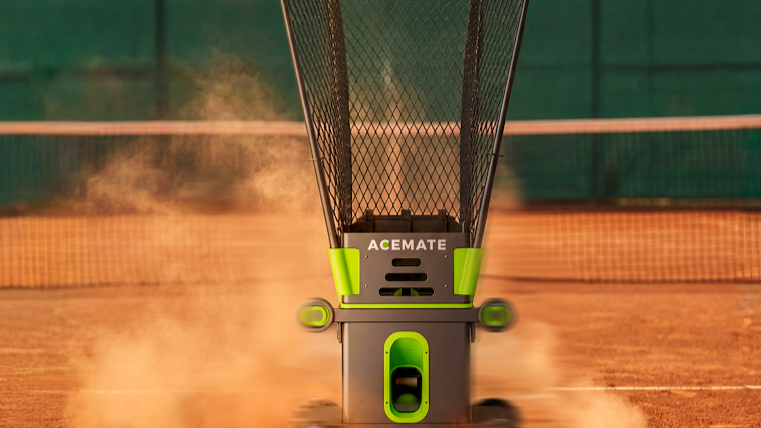
A ball machine repeats a setting, not a result. That one fact explains everything weather does to your practice. Heat raises the pressure inside the ball and thins the air, so your usual feed lands deeper and bounces higher. Cold does the reverse and cuts battery run time on top of it. Wind edits the trajectory after the ball has left the machine. Moisture changes how the felt grips the throwing wheels, which changes pace and spin without touching a single control. A person feeding by hand corrects for all of this without thinking about it. A machine will fire the same wrong ball two hundred times and never notice.
What Weather Actually Changes About Ball Machine Performance
Weather acts on four separate things: the ball, the air it flies through, the machine's grip on the ball, and the battery. They do not move together, which is why "it's cold out" is not one adjustment.
The Ball
A pressurized ball holds air above atmospheric pressure, and that pressure tracks temperature. Warm it and the ball gets livelier and bouncier. Cool it and the pressure drops, the rubber core stiffens, and the ball compresses less on impact, which is the dead, heavy feel players describe in winter.
Pressureless practice balls get their bounce from the rubber shell instead of trapped air, so they lose less in the cold, though the rubber still stiffens and the ball feels heavier year round.
The Air It Flies Through
Air density sets how much drag the ball meets. Hot air is less dense, so the ball carries farther and arrives faster. Cold air is denser, so the same feed slows sooner and lands shorter. Spin magnifies both: a heavy topspin feed depends on airflow to curve and dip, so spin-heavy ball flight shifts more between conditions than a flat feed does.
The Grip at the Throwing Wheels
Most machines launch the ball by squeezing it between counter-rotating wheels, so exit speed and spin come from friction against the felt rather than from the dial you set. Damp felt slips. Cold-stiffened felt compresses less against the wheels. Worn felt grips differently than new felt. All three produce balls that vary from one feed to the next while the setting you chose stays identical, which is why inconsistency that appears out of nowhere usually points at the balls rather than the machine.
The Battery
Lithium-ion cells release less of their stored energy when cold, so a battery-powered tennis ball machine that covers a full session in mild weather can come up short on a winter morning. The capacity is not lost permanently. It returns as the pack warms. It is simply gone for the session you are standing in.
Manufacturers publish an operating range for this reason. Acemate specifies 32°F to 104°F (0°C to 40°C) for the Acemate S10, and its FAQ lists ambient temperature outside that range as a reason the robot may not power on at all.

How Wind Changes Where Your Feeds Land
Wind moves the landing point rather than the pace, and the machine has no way to compensate. It fires the same trajectory every time and the wind rewrites it in flight.
A headwind shortens the feed and makes topspin dip earlier, because the ball meets more airflow and the spin bites harder. A tailwind pushes the ball deep and flattens the arc, which is how a well-set drill starts landing long. A crosswind is the worst case, because it moves the ball sideways and your targets stop meaning anything.
Height decides how much wind gets to act. Lobs, overhead feeds, and high topspin spend the longest in the air and drift the most, while low flat feeds are the most stable thing you can run on a windy day.
- Drop the launch angle so the ball spends less time exposed.
- Aim into the wind so drift carries the ball back toward the target instead of past it.
- Feed down the middle rather than to the corners, since a crosswind turns a corner feed into an out ball.
- Move overheads and lob work to a calmer day.
- Rotate the machine so a crosswind becomes a headwind or tailwind if the court layout allows it.
How Heat Affects Tennis Ball Machine Performance
In heat everything gets faster and deeper. Warm balls carry more internal pressure and thin air offers less resistance, so a setting you dialed in during April plays noticeably deeper and higher in August.
Balls also wear out faster. Hot hard courts are abrasive and warm felt shreds more quickly, and since the wheels grip that felt, balls that held up for a week in spring can turn inconsistent much faster in midsummer.
For the machine, heat is a storage problem more than a running problem. A closed trunk in summer gets far hotter than the air outside, and sustained heat is hard on lithium-ion packs. Bringing the machine and batteries indoors between sessions costs nothing.
- Take the speed down a step and check depth before assuming the drill is set right.
- Expect a higher bounce and raise your target height if players are hitting late.
- Park the machine in shade between blocks.
- Retire balls sooner than you would in cooler weather.
- Shorten sessions. Heat limits the player long before it limits the machine.
How Cold Affects Tennis Ball Machine Performance
Cold is the condition that most often limits the machine itself rather than just the ball. The ball loses internal pressure and stiffens, denser air slows it further, and the feed lands short and sits low even though nothing about the setting changed. Then the battery gives you less time to work with.
- Keep balls indoors until you use them and rotate a warm set from your bag between blocks. Cold balls recover within a few minutes of warming, so this genuinely works.
- Keep the battery in the car cabin rather than the trunk until you start, and carry a charged spare. On the S10 the battery is user-replaceable, so a swap keeps the session going.
- Raise the launch angle to restore depth rather than adding speed, which changes how the ball plays as well as where it lands.
- Check the manual before charging a pack that has been sitting in the cold. Lithium-ion batteries usually have a narrower safe temperature window for charging than for discharging.
- Let a cold machine sit a few minutes after you carry it into a warm room, since condensation forms on cold electronics in warm air.
How Humidity and Wet Balls Change the Feed
Humidity works on the ball two different ways, and they point in opposite directions.
Aerodynamically, humid air is slightly less dense than dry air, because water molecules are lighter than the nitrogen and oxygen they displace. On its own that would make the ball carry marginally farther. But the felt absorbs moisture, and a heavier ball with soggy nap flies slower, bounces lower, and grips the throwing wheels unpredictably. The felt effect is far larger than the air effect, which is why humid days feel slow even though the air is technically thinner.
For a machine, damp felt is the practical problem. It is a common reason a machine that was consistent yesterday scatters balls today, and no settings change will fix it. Acemate's manual asks specifically for dry balls and warns against wet or damaged ones. Swap in a dry set, keep spares in a sealed bag, and clear felt fuzz from the machine's interior afterward, which Acemate's manual lists as routine maintenance after every session.
Rain is a harder stop. Acemate's manual limits use to an indoor tennis court in rain, snow, or a sandstorm, and how fast a court becomes unusable depends on the surface you train on, since clay holds water very differently from a hard court. Either way it turns into a player safety question before it turns into an equipment one.

How Sun, Glare, and Low Light Affect Camera-Based Robots
Vision-based robots have a weather sensitivity older machines never had, and it has nothing to do with temperature. They read the court and track the ball with cameras, so lighting conditions change what they can do.
Strong backlighting is the main culprit. Acemate recommends its backlight mode in high-contrast or sunny conditions to improve ball catching, and the S10's rally mode depends on clearly visible court lines to locate itself. Anything that makes those lines hard to read, including glare off a wet court or leaves across the markings, can cost the robot its position reference, and the manual also advises against operating in low light.
Practically, this makes the calendar matter. Fall and early spring, when the sun sits low through the entire after-school and after-work practice window, are when glare settings earn their place. If you have a choice of ends, put the machine where the low sun sits behind its cameras rather than in front of them, and accept that this puts the glare on the players instead.
How Altitude Changes What Your Settings Produce
Altitude works like permanent heat and hits harder than any single day of weather. Thinner air means less drag, so feeds fly faster, land deeper, and spin bites less, which is why a machine dialed in at sea level plays long in Denver or Albuquerque.
Reduce speed and add spin rather than trying to fix depth with the launch angle alone, since less spin bite is what is really costing you control. Ball makers sell high-altitude balls for exactly this reason, and they are worth using if you train at elevation regularly. Teams traveling to altitude for a tournament should plan a session to reset settings rather than assuming their home numbers transfer.
Settings to Adjust for Each Condition
Treat these as starting points and verify with a few live feeds. Conditions change what a setting produces, so the only real check is where the ball actually lands.
|
Condition |
What you see on court |
What to change |
|
Headwind |
Short feeds, topspin dips early |
Lower the launch angle, add a step of speed, aim deeper |
|
Tailwind |
Feeds land long or push players behind the baseline |
Reduce speed, flatten the arc, target the service line area |
|
Crosswind |
Balls drift off target, corner feeds go wide |
Feed down the middle, drop the height, drop target scoring |
|
Heat |
Deeper, livelier, higher-bouncing balls |
Reduce speed, expect a higher bounce, replace balls sooner |
|
Cold |
Short, low, dead-feeling balls and shorter run time |
Raise the launch angle, keep balls and battery warm, plan a shorter session |
|
Humid or damp |
Pace and spin vary ball to ball for no clear reason |
Swap in dry balls. This is not a settings problem |
|
Altitude |
Everything flies long, spin does less |
Reduce speed, add spin, consider high-altitude balls |
|
Low sun or glare |
A camera-based robot tracks poorly or loses position |
Turn on a backlight mode if the machine has one, switch ends, clear debris off the lines |
When to Move Indoors or Stop
Stop when conditions leave the machine's rated range, when the court is wet, or when the wind makes the drill meaningless. Three other stopping points are worth agreeing on before you need them.
Standing water or a slick surface. A safety call first, and it does not improve with better settings.
Wind strong enough that you cannot land two feeds in the same spot. At that point you are practicing reactions to random balls, which is not what the drill was for.
Lightning anywhere nearby. Clear the court and take the machine with you.
When the outdoor window closes for the season, the drills transfer with minor changes to indoor tennis training, where none of these variables move at all. For technical work, that stability is an advantage rather than a compromise.
Frequently Asked Questions
Do Tennis Balls Recover After Being Used in the Cold?
Yes. Pressure loss from cold is temporary, and balls return to normal bounce within a few minutes indoors. What does not come back is felt wear, so a ball that still feels dead after warming up is worn out rather than cold.
Are There Tennis Balls Made for Cold Weather or High Altitude?
High-altitude balls are a standard category and are worth using if you train at elevation. For cold, there is no dedicated ball, but pressureless balls hold their bounce better since it comes from the rubber shell rather than trapped air.
Does Wind Affect a Ball Machine More Than a Coach Feeding by Hand?
Yes, and this is the real difference. A coach sees the last ball drift and adjusts the next one. A machine repeats the same trajectory regardless of outcome, so wind errors accumulate instead of correcting themselves.
What Temperature Is Too Cold for Tennis?
No governing body sets a number. In practice the limits are ball bounce, hand feel, and the injury risk of cold muscles, and players usually reach their limit before the equipment does. Check your machine's rated range separately.
Do You Need to Recalibrate a Machine After a Change in Conditions?
No. Camera calibration on a robot like the S10 relates to court position and markings, not weather, and Acemate notes that no recalibration is needed for the same court under normal operation. Recalibrate when you change courts or tracking degrades.
Check the Conditions Before You Check the Settings
The fastest way to waste an outdoor session is to assume the machine drifted when the weather moved. Feed five balls before the drill counts and watch where they land. Short and low points at cold or tired balls. Long points at heat, a tailwind, or altitude. A different spot every time points at damp felt or wind. Fix the cause you actually have, not the one the settings screen makes easiest to change.
Beyond Traditional Tennis Ball Machines: A More Adaptive Training Approach
Traditional tennis ball machines are built around preset feeds, which means they repeat the same output even when weather conditions change the result. An AI tennis robot takes a different approach by using vision, movement, and training data to create a more responsive practice experience.
Acemate S10 Pro combines AI vision, autonomous court movement, Rally, Drill, Serve, Ball Machine, and Battle modes to support different training goals. Instead of only repeating feeds, S10 Pro helps players build a more complete training routine with interactive practice and post-session performance insights.
