
Every drill below runs off the same setup: alternate a deep, heavy feed with a short, attackable one, and start inside the baseline so the first ball pushes you back into a real defensive position. From there the seven drills build the pattern in order, from the reset ball that buys time, to the read that tells you when to step in, to the full sequence played for a score.
One thing separates these from ordinary movement drills. Turning defense into offense is a three-ball sequence, not a two-ball one, and the middle ball is the one that rarely gets practiced.
How to Set Up the Machine
Four settings and one starting position cover every drill on this page. The chained sequences need a tennis machine that can change depth from shot to shot; the first two drills run off a single feed and work on anything.
- Machine position. Opposite baseline, centered, for all the depth-change drills. Move it near the opposite service line and raise the elevation only for the high defense drill, and put it off to one side there so your overhead is not aimed back at it.
- Depth. Alternating deep and short inside one sequence. Depth comes from launch elevation and speed together, not from moving the machine, so leave the machine where it is once the block starts.
- Speed and spin. Medium relative to your normal rally pace, with moderate to heavy topspin on the deep ball. Most apps set speed on a 1 to 10 scale rather than in mph, so find the number that matches your rally pace once and describe everything else against it.
- Interval. 4 to 5 seconds for the sequence drills, 6 to 8 when you are moving backward and forward on every ball.
- Safety. Never reach into the launch port or the ball hopper while the machine is powered on, and power it off before clearing a jam.
- Where you stand. Start a step inside the baseline, not behind it. The deep heavy ball then pushes you back, which is how a machine manufactures a defensive position instead of just handing you a deep ball you were already waiting for.
That last point is easy to skip, and skipping it is why a lot of transition drills feel nothing like a match.
Drills 1 and 2: Build the Neutral Ball
Two drills for the shot that resets a point rather than ends it.
|
Drill |
Placement |
Speed |
Spin |
Elevation |
Interval |
Target |
|
Deep heavy reset |
One deep corner, one wing at a time |
Medium to fast |
Heavy topspin |
25 to 30 degrees |
6 to 8 sec |
8 of 10 past the service line, well over the net |
|
Reset and recover |
Alternating deep corners |
Medium |
Heavy topspin |
25 to 30 degrees |
5 to 6 sec |
Back inside the center mark before each ball launches, 20 balls |
Deep Heavy Reset
Start inside the baseline, let the ball drive you back, and hit every reply high and deep crosscourt. Aim four to six feet above the net rather than at a line. The neutral ball is judged on net clearance and depth, so count what lands past the service line and ignore how it felt. The reset ball is usually flatter than it feels, which is why it lands short and invites the attack it was supposed to prevent.
Reset and Recover
Same shot, now with movement. Alternating deep corners forces you to hit the reset while traveling, which is the only version that appears in a match. Count whether you get back inside the center mark before the next ball leaves, not winners. If you cannot, add a second to the interval rather than accepting a drill where recovery footwork quietly disappears.
Drills 3 and 4: Read the Ball Before You Commit
Two drills that separate the decision from the stroke, so one cannot hide the other.
|
Drill |
Placement |
Speed |
Spin |
Elevation |
Interval |
Target |
|
Call it before you hit it |
Deep and short alternating |
Medium |
Light topspin |
25, then 15 degrees |
5 to 6 sec |
9 of 10 correct calls before shot quality counts |
|
Above-the-net rule |
Mixed depth |
Medium |
Alternating topspin and slice |
15 to 25 degrees |
5 to 6 sec |
Zero attacks on balls contacted below net height, 20 balls |
Call It Before You Hit It
Split step, then say "defend," "neutral," or "attack" out loud as the ball crosses the net, and play the shot that matches the call. For the first two sets, score only the call. Reading correctly and executing badly is progress. Reading wrong and hitting a clean winner is luck you cannot repeat. Calling out loud is awkward on a public court and it is one of the quickest ways to find out how often you misjudge depth.
Above-the-Net Rule
One rule for the whole block: if you contact the ball below the height of the net, you are not allowed to attack it. Reset instead. Alternating topspin and slice is what makes this work, because a low skidding slice lands short and looks attackable while giving you nothing. This is the drill that fixes attacking one ball too early, and failing it for the first several sets is normal.
Drills 5 to 7: Run the Full Sequence
Three drills that chain the pattern together, ordered by difficulty.
|
Drill |
Placement |
Speed |
Spin |
Elevation |
Interval |
Target |
|
Defend, neutralize, attack |
Deep, then mid-depth, then short |
Fast, medium, medium |
Heavy, light, flat |
30, 20, 15 degrees |
4 to 5 sec |
3 sets of 10 sequences, 5 of 10 complete per set |
|
High defense to overhead |
High deep lob, then short ball |
Slow, medium |
Flat, then light topspin |
35 to 40, then 15 degrees |
6 to 8 sec |
12 of 20 sequences finished into an open corner |
|
Scored transition game |
Rotating deep, mid, and short |
Medium to fast |
Mixed |
30, 20, 15 degrees |
4 to 5 sec |
Play to 7 |
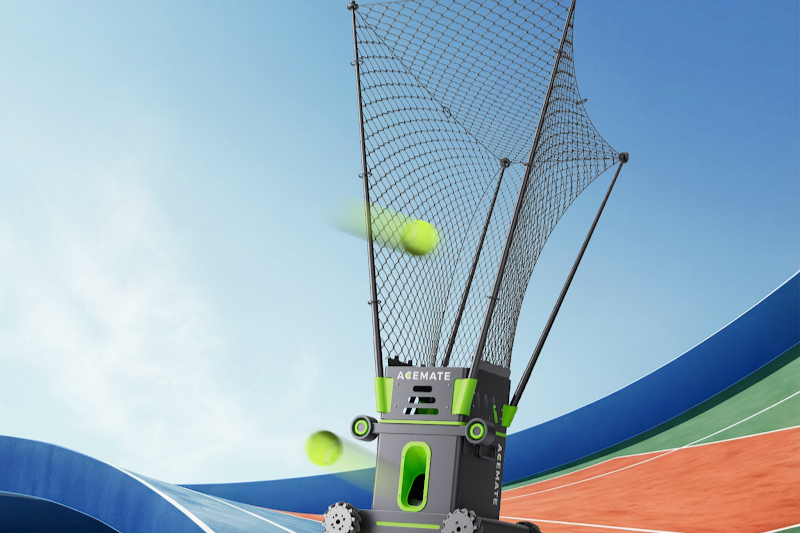
If you are using the Acemate S10 Pro, its ACE+ SHOT™ system gives you control over pace, spin, placement, trajectory, and tempo, including deep balls, lobs, and transition shots. That makes these three-ball patterns especially useful for building a clear change of state within one sequence: defend the first ball, neutralize the second, then step in on the third.
Defend, Neutralize, Attack
The core drill. Three balls: a deep heavy one you defend, a mid-depth one you neutralize and recover behind, and a short one you attack. Take the short ball on the rise and move through it, because stopping to hit it puts you back where you started. The third ball must be struck from inside the baseline for the sequence to count, which is the condition that stops this from becoming three groundstrokes in a row. A harder version makes the second ball wide, so you neutralize while running rather than from a balanced base.
High Defense to Overhead
A common pattern in club singles, and one that gets little practice because it needs a feeder willing to throw lobs. Take the high ball deep to buy time, move forward as the short reply comes, and finish the overhead into an open corner rather than at the middle. Long interval, because you travel backward and then forward on every sequence. Twenty sequences is plenty. Set the machine off to one side for this one so the overhead is never aimed back at it.
Scored Transition Game
Play to 7 against the machine. You win a point only by completing a full defend, neutralize, attack sequence with the attacking ball landing in. Attacking directly off the defensive ball gives the point to the machine even if the ball lands in. Scoring it this way is deliberate: the habit being trained is patience on the middle ball, and nothing enforces patience like losing points for skipping it.

When to Attack and When to Reset
The three states are defined by where you are and where you contact the ball, not by how hard you hit it.
|
State |
Where you are |
Contact height |
What the ball should do |
|
Defending |
Behind the baseline, off balance or on the run |
At or below waist, often below net height |
Buy time: high, deep, usually crosscourt |
|
Neutralizing |
Recovering toward the center, balanced |
Between waist and shoulder |
Push the opponent back and reset your position |
|
Attacking |
Inside the baseline, moving forward |
Above net height |
Take time away: flatter, into space, then close |
The common error is attacking one ball too early, and contact height is what gives it away. A short ball that skids and forces contact below the net has to be hit up to clear the net and up again to bring it down, which is a low-percentage shot from a position that felt aggressive. The same ball taken one step later, above net height, is a straightforward attack. The read is not depth alone. It is depth plus bounce plus where your feet are when you arrive.
Surface changes this directly. A ball that sits up on hard court skids low on grass and kicks higher on clay, so the same feed produces a different contact height and a different correct decision across court surfaces. Re-tune the launch elevation whenever you switch surfaces rather than carrying the settings across.
Machine Limits and How to Work Around Them
Three constraints affect these drills more than they affect ordinary groundstroke work.
A fixed interval reverses match tempo. A real defensive ball buys you time. A short attackable ball takes it away. On the Acemate S10, as on programmable machines generally, the shot interval stays constant across a sequence, so the gap after your deep reset is identical to the gap after the short ball. Set the interval for the tightest ball in the sequence, usually the attack, and accept that the defensive legs feel slower than they should. Alternatives: recovery-based feeding where the timing follows the player, or machines that return your shots and take their tempo from the exchange. Starting each sequence yourself also helps, since you control the gap between them even if you cannot control the gap inside them. The app handles start and pause, and the S10 also supports Apple Watch control, so the block can be run without walking back to the machine.
A machine that cannot change depth mid-sequence. Fixed and simple oscillating machines feed one depth, which rules out the chained drills. Split the sequence instead: run ten deep balls as a reset block, then move the machine forward and run ten short balls as an attack block. You lose the transition itself but keep both halves, and the read drills still work if you alternate topspin and slice at one depth. Whether your machine can run the chained versions comes down to whether it is a programmable model or a fixed one, which is the first thing to check when comparing machines.
No full court. Drills 3 and 4 work anywhere there is a net, since the read is about contact height rather than where the ball lands. Everything else needs real lines, because the targets are defined by the service line and the baseline and there is no honest way to judge depth without them.
If you have a hitting partner instead of a machine, hand-feeding the three-ball sequence is the closest substitute and the easiest to set up.
Reps, Rest, and Fitting It Into a Session
The ceiling is 10 to 12 balls in a row for anything that moves you this much, then 15 to 20 seconds of rest before the next set.
Transition sequences degrade faster than baseline drills because every ball changes your court position. Past a dozen consecutive balls the recovery steps get shorter and the reps start teaching the tired version of the pattern, which is the opposite of the point. Three sets of 10 sequences with real rest between them beats one long block.
An 80-ball hopper covers roughly 26 three-ball sequences, which is two full sets of the core drill plus a short scored game before you collect. Plan the block around that number rather than around the clock. Put this work in the middle of a session, after a fixed-feed warm-up and before you are tired enough that the read goes first. The full drill library covers the groundstroke and movement blocks these sequences assume you already have.

How to Tell It Is Working
Judge it by where you are standing when you hit the third ball, not by whether it went in.
- Your reset balls start landing past the service line instead of in the middle third.
- You stop attacking balls contacted below net height, which shows up first as fewer errors rather than more winners.
- You arrive at the short ball already moving forward instead of stopping to hit it.
- Points in matches last one or two balls longer before you commit, and the ones you commit on end better.
The S10 session record tracks average net clearance and a landing map alongside shot count and in/out rate, which is useful here because the neutral ball is judged on net clearance and depth, and those are the two the record shows. Its preset library also includes an attack and defense transition drill, which is a ready-made starting point before you build sequences by hand.
Frequently Asked Questions
What Are the 5 R's in Tennis?
Ready, Read, React, Respond, and Recover, a footwork framework developed by coach Dave Bailey that describes what a player does on every ball. It maps onto these drills closely: the calling drill trains Read, and the neutral ball is Recover doing its job inside a rally rather than after it.
What Level Should Start These Drills?
Around 3.5 and up for the full three-ball sequences, since they assume you can already direct the ball on both wings. Below that, run the two neutral-ball drills on their own. A reliable high, deep, crosscourt reset is worth more at 3.0 than any attacking pattern.
Is a Neutral Ball the Same as a Moonball?
No. A moonball is a high, slow ball hit as a tactic in its own right, often to disrupt rhythm. A neutral ball is a job inside a sequence: enough height and depth to push the opponent back while you recover court position, then back to normal rally pace. Same shape, different purpose.
Should the Attacking Ball Go Crosscourt or Down the Line?
Down the line from a short ball on your forehand side, crosscourt when the short ball pulls you wide. Change direction only when you are balanced and contacting above net height, because changing direction off a low or stretched ball is where transition errors cluster.
