
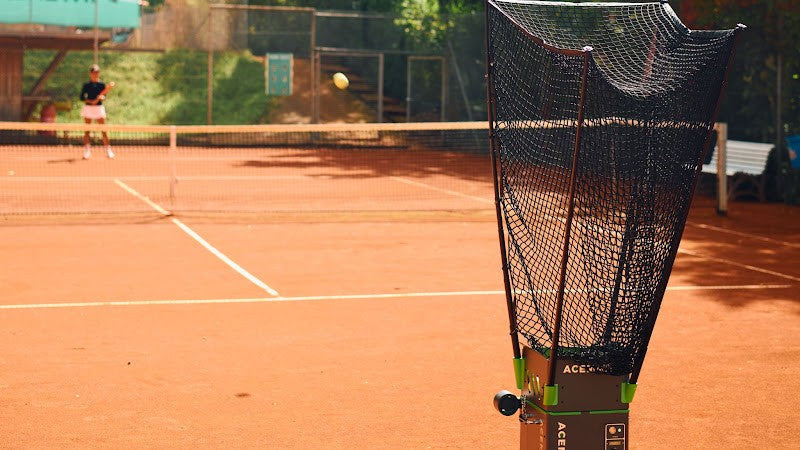
Run about 12 minutes of hitting, roughly one 80-ball hopper, starting with soft short-court feeds and finishing at the pace you expect in the match. Set the speed dial low, the interval long, and raise both in stages rather than starting where you left off in your last practice. A machine gives you something a hitting partner cannot: repeatable balls at a pace you control, which is exactly what a warm-up needs. It also asks for one adjustment, since the first ball arrives at whatever you set with no gentle feed to ease into, so the ramp has to be built into the settings.
What to Do in the Two Hours Before Your Match
Work backward from the start time so the hitting ends close enough to the match that you stay warm.
|
Time before the match |
What to do |
|---|---|
|
2 hours |
Finish eating, start hydrating, pack your bag. No hitting. |
|
60 minutes |
Arrive and move for five minutes: leg swings, hip openers, arm circles, shadow swings, and a few split steps. |
|
50 minutes |
Set up the machine and run the 12-minute hitting block. |
|
35 minutes |
Serve 20 to 30 balls. |
|
25 minutes |
Water, dry shirt, sit down. Review the two patterns you plan to play. |
|
10 minutes |
On-court warm-up with your opponent. |
The 60-minute mark assumes the machine is already at the court. Add five minutes if you are carrying it in from the parking lot and setting it up yourself.
The gap between the machine block and the first point matters more than most players think. Finishing 45 minutes early means going cold again, and finishing two minutes before means arriving out of breath. Twenty to thirty minutes of quiet after you hit leaves you warm and settled.
Machine Settings for a Pre-Match Warm-Up
Start every setting lower than your practice defaults and move up in three steps. On the Acemate S10 that means the speed dial in the low range, elevation in the middle, spin near flat, and a longer feed interval than you would use for a drill.
|
Stage |
Speed dial |
Elevation |
Spin |
Interval |
Feed placement |
|---|---|---|---|---|---|
|
Short court |
2 to 3 |
25 to 30 degrees |
Flat |
7 to 8 sec |
Center, landing around the service line |
|
Baseline contact |
3 to 4 |
20 to 25 degrees |
Light topspin |
5 to 6 sec |
Center, landing mid-court |
|
Movement |
4 to 5 |
20 to 25 degrees |
Light topspin |
5 sec |
Alternating sides |
|
Match pace |
5 to 6 |
20 to 25 degrees |
Match the opponent |
4 sec |
Mixed depth |
If you are warming up with the Acemate S10 Pro, use the same progression rather than copying the S10 dial numbers directly. The S10 Pro supports adjustable 1–15 second feed intervals, speeds up to 75 mph, and a wider range of shot angles, so begin at the lower end of your normal settings and increase pace only as your timing settles. For a pre-match warm-up, the extra range is there to match the ball you expect to face, not to test the machine’s maximum speed.
Three details make the difference between a warm-up that works and one that costs you the first game.
Send one test ball before you take position. Watch where it lands from behind the machine. A single ball catches a wrong setting before it eats the first thirty seconds of a twelve-minute block.
Fill the hopper with the balls you are about to play with. Many players keep pressureless balls for machine work because they last, and those balls feel heavier and bounce lower than the fresh pressurized can that comes out for a league match. Warming up on one and playing with the other builds your timing around the wrong ball, so on match day use the type of ball you will actually face.
Start the interval long. A short feed rate makes you rush before your body is ready, which is the opposite of what a warm-up is for. Bring it down as you loosen up. Feed rate is the setting that decides whether you are recovering between balls or only reacting to them.
Nothing about how you set up the machine changes for a warm-up. Only the numbers do. One constraint shapes how you program it: the interval applies to a whole sequence and stays the same throughout it, so run the warm-up as separate short sequences and change the interval between them.

The 12-Minute Warm-Up Routine
Six stages, about 80 balls, which is one full hopper on the S10. Count balls rather than watching the clock, since a hopper empties at the same point every time and gives you a natural stopping cue.
- Short court, 15 balls. Stand inside the service line and hit soft crosscourt. This is the stage most often skipped, and it is the one that finds your contact point. On a standard court, a machine that returns your shots does the same thing in rally mode with the vertical position set to 1 or 2, which is its mini-tennis range. Stay at least seven feet, or two meters, from the machine while it is moving.
- Baseline center, 15 balls. Move back and hit down the middle with no target beyond depth. Alternate forehand and backhand as the feed allows.
- Two-line movement, 20 balls. Alternate sides so you are moving between shots, and put a cone on the center mark to touch between balls. The recovery step is the part that gets your legs going, and it is the first thing that disappears when you are only thinking about the ball. The preset library has two-line patterns ready if you would rather not program one.
- Short ball and approach, 10 balls. Lower the elevation and let the ball land near the service line, then move forward and finish at the net. This wakes up the forward movement most warm-ups leave out.
- Overheads, 5 balls. Raise the elevation and hit a few smashes. Five is enough to find the timing without emptying your shoulder before the match.
- Match pace, 15 balls. Raise the speed a step and shorten the interval to about 4 seconds, so the last thing your body remembers is the tempo you are about to play at. Ending soft undoes most of what the previous five stages built.
Stop when the hopper is empty even if you feel like hitting more. One hopper is a warm-up. Two is a workout you are carrying into the match, and the temptation to run a second one is strongest on the days you are hitting well.
How to Warm Up Your Serve
Serve 20 to 30 balls after the machine block, working from half pace to full, and finish with four or five at the target you plan to use on the first point.
The serve is usually the coldest shot in the first game, since it is the only stroke nobody else can start for you. Keep it to rhythm rather than mechanics on match day. Short serve drills aimed at a target work better than free-hitting here, since a target keeps you out of technical thinking. Ten minutes of tinkering with your toss half an hour before a match is a good way to arrive without one.
Serve returns are worth two minutes at the end of the machine block instead. Raise the speed a step, shorten the interval, and take the ball early from inside the baseline. The trajectory is not identical to a serve, but the split step and the early contact are the parts you need warm.
How to Fix Timing Problems in the Warm-Up
Change the settings, not your stroke. A ball that feels wrong in the warm-up is usually a timing problem, and timing responds to feed changes within a few balls.
- Late on everything. Lengthen the interval by a second and drop the speed a step. You are behind because you are not moving yet, not because your swing is broken.
- Hitting long. Check the elevation first. A high feed produces a high bounce, and a high bounce sends the ball long while you are still tight.
- Hitting into the net. Raise the elevation a step and aim four feet over. Cold arms shorten the follow-through, and extra clearance covers it.
- One wing feels dead. Give it 10 more balls at low speed and centered, then move on.
Whatever you find, leave technique alone until the match is over. Changes to a stroke take weeks to hold, so hitting 150 forehands an hour before you play will leave you tired without fixing anything. Warm up the ball shape you have today and build the match plan around it.
How to Adjust the Warm-Up for Cold, Heat, and Wind
Cold changes the ball more than it changes you. Pressurized balls lose bounce as the temperature drops, so a sequence calibrated on a warm day lands shorter and sits lower, and you should expect to add a step of speed or elevation to reach the same landing zone. Cold also needs a longer ramp, so add five balls to the short-court stage and hold the interval at the long end for an extra minute.
In heat, cut the movement stage and keep the rest. You do not need a machine to raise your heart rate at 95 degrees, and the warm-up should leave you loose rather than soaked.
Wind is the awkward one, since a crosswind moves the feed and your landing zones stop being reliable. Set up so the feed travels with or against the wind rather than across it, and treat depth as approximate that day. On an indoor court, none of this applies, and the settings you calibrated last time will behave the same way again.
What to Record After Each Warm-Up
Note the speed dial setting you finished on. Across a season it shows whether you are arriving ready or arriving cold, and it makes the next setup faster because you start closer to the right numbers.
The Acemate S10 stores warm-up sequences as saved training plans, so a routine you build once loads in a few taps on the morning of a match. Its session data also records total shots and average net clearance, which is a useful check on whether your clearance is drifting down over a run of cold weeks.
Frequently Asked Questions
Should I Use a Ball Machine on Match Day?
Yes, treated as a warm-up rather than a practice session. One hopper at rising pace gets your timing and footwork ready. The risk is volume, since a full practice session an hour before a match leaves your legs flat in the third set.
Can I Use a Ball Machine at the Match Venue?
Often not on the match court itself. Many clubs restrict machines during league play or reserve them for booked practice courts. Call ahead. If the answer is no, reserve an adjacent court, warm up at your usual facility beforehand, or get five minutes of contact off a practice wall.
What if I Only Have Ten Minutes?
Cut the overheads and the approach stage, and split the rest evenly: five minutes short court and baseline, five minutes at match pace. Keep the short-court stage no matter how short the session gets, since it does the most for your contact point.
Should I Warm Up on the Machine the Morning of an Evening Match?
A short morning session is fine at 20 to 30 balls, purely to feel the ball. Anything longer becomes training on match day. Do the real warm-up in the hour before you play, since the morning session will have worn off.
What Should I Do if My Match Gets Delayed?
After about 20 minutes of waiting, redo a short version: 15 to 20 balls at low speed and a long interval, plus two minutes of movement. A full second warm-up costs you more than the delay does.
