
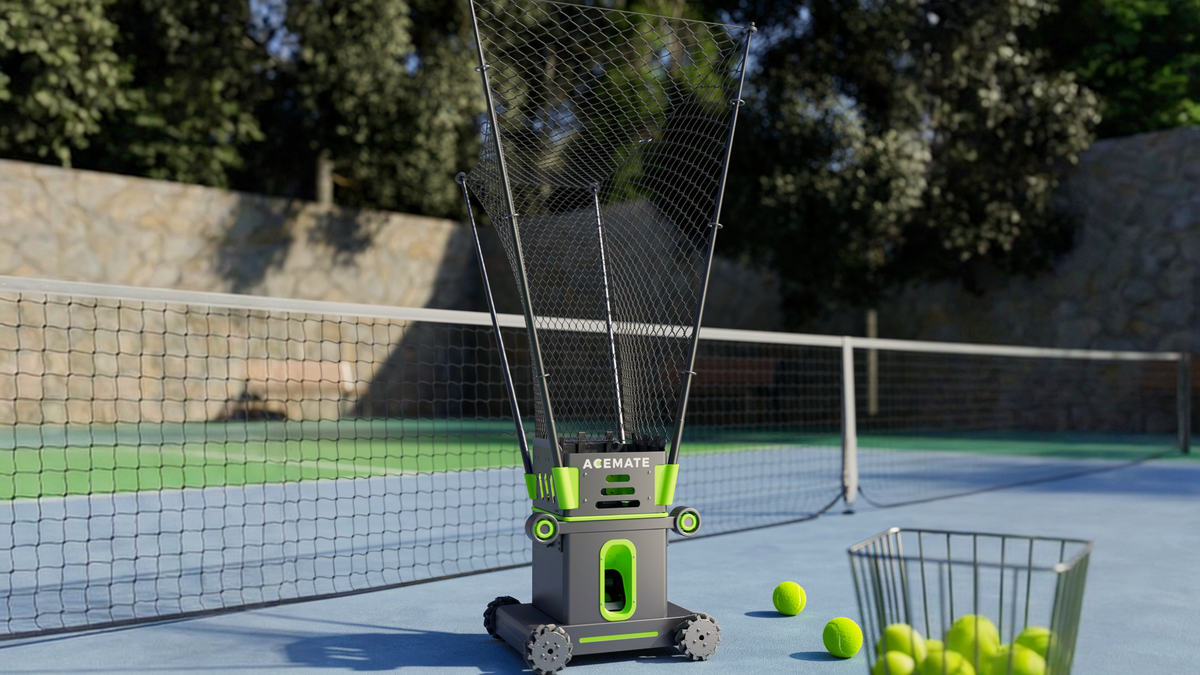
Choose the Acemate S10 for sessions of one to two hours that you set up and carry yourself, and for feeding juniors or first-time players. Choose the Acemate S10 Pro for back-to-back training, for drills that pull you into both corners, and for pace beyond 60 mph. Both robots run the same AI platform and the same five training modes, so the difference sits in four places: ball speed, placement range, session length and weight.
Acemate S10 Pro vs S10 at a Glance
The two robots differ on ball speed, placement range, battery, ball capacity and weight. Everything else on the spec sheet matches.
|
Acemate S10 Pro |
Acemate S10 |
|
|
Ball speed range |
18 to 75 mph (30 to 120 km/h) |
6 to 60 mph (10 to 97 km/h) |
|
Battery life |
Up to 5 hours |
Up to 3 hours |
|
Ball capacity |
100 balls |
80 balls |
|
Balls before a collection break |
About 300 equivalent |
About 240 equivalent |
|
Weight |
50.7 lbs |
37.5 lbs |
|
Shot delivery |
ACE+ SHOT, 0 to 180 degrees of internal coverage |
Per-shot aim within 15 degrees either side of center |
|
Vision |
Dual 4K HDR stereo |
Dual 4K HDR stereo |
|
Training modes |
Rally, Drill, Battle, Ball Machine, Serve |
Rally, Drill, Battle, Ball Machine, Serve |
|
Preset drills |
100+ |
100+ |
|
Custom drills |
Unlimited |
Unlimited |
|
Movement |
Omnidirectional, up to 5 m/s |
Omnidirectional, up to 5 m/s |
|
Control |
iOS, Android, Apple Watch, Wear OS, gesture |
iOS, Android, Apple Watch, Wear OS, gesture |
|
Recommended range |
NTRP 1.0 to 7.0 |
NTRP 1.0 to 5.0 |
What stays the same: dual 4K HDR stereo vision, the on-court loop of seeing, deciding, moving, catching and returning, all five training modes, 100+ presets with unlimited custom drills, omnidirectional movement up to 5 m/s, and control from iOS, Android, Apple Watch, Wear OS or a gesture. Ball Machine mode on both models covers the same repeatable feeding a standard tennis ball machine provides, with Rally, Drill, Serve and Battle built on top of it.
What the S10 Pro adds: 15 mph more pace at the top of the range, 180 degree placement from a fixed body position, two more hours of battery, 20 more balls, and the ACE+ SHOT delivery system behind them.
Key Differences Between the S10 Pro and S10
Four differences change how a session runs: ball speed, placement, session length and weight.
Ball Speed and Shot Power
The S10 Pro delivers 18 to 75 mph and the S10 delivers 6 to 60 mph. The Pro's advantage sits at the top of the range and the S10's at the bottom, where it feeds 12 mph slower than the Pro can.
What this means on court: 15 mph at the top end takes roughly two tenths of a second off the flight time of a baseline-to-baseline ball before drag and the bounce are taken into account, which lands squarely in the window a player uses to turn the shoulders and step in. On the S10's fastest setting, a player still generating the intensity themselves has reached the machine's limit rather than their own. At the other end, the S10 opens a band between 6 and 18 mph that the Pro does not reach, which is the range a coach uses for young juniors, first lessons and warm-ups. Acemate rates the S10 for NTRP 1.0 to 5.0 and the S10 Pro for 1.0 to 7.0, which brackets the intended range rather than fixing a cutoff.
Placement and Court Coverage
The S10 Pro aims through a 180 degree arc by rotating its launch head internally, with the body staying where it is. The S10 aims each shot within 15 degrees either side of where the machine faces and turns its body to open up wider angles. On both models placement is set shot by shot rather than by an oscillation sweep.
What this means on court: the difference depends on depth. From the center of the baseline, a 15 degree window opens to roughly 20 feet either side by the time the ball reaches the far baseline, which covers the full 13.5 foot singles half-width on deep balls. At mid-court depth the same window narrows to about 10 feet, so short angled balls sit outside it and the S10 turns to reach them. The S10 Pro's arc is independent of both depth and where the machine is standing, which is what makes short cross-court angles, corner-to-corner recovery patterns and approach balls repeatable inside one sequence.
Session Length: Battery and Ball Capacity
The S10 Pro runs up to five hours and holds 100 balls. The S10 runs up to three hours and holds 80. Because both catch and return balls during a rally, the practical figure before stopping to collect is about 300 balls on the Pro and 240 on the S10.
What this means on court: at a five second feed interval, 240 balls is roughly 20 minutes of continuous hitting and 300 is roughly 25, which over a two-hour session works out to roughly one extra collection break on the S10. Battery works on a larger scale. Three hours covers two hour-long lessons with margin, while five covers four plus setup between them, which is the difference between charging overnight and charging at lunch. The gap between ball collection and continuous rally widens as sessions get longer.
Weight and Getting It to the Court
The S10 weighs 37.5 lbs and the S10 Pro 50.7 lbs. The two are close in overall size, so the difference shows up in the lift rather than in storage.
What this means on court: both robots can be driven across the court from the app, so the lift that matters is the one in and out of the trunk. At 37.5 lbs the S10 is a straightforward lift over a trunk lip for most players. At 50.7 lbs the S10 Pro is a two-handed lift, which is why it carries handles on both sides. Flat ground and a low tailgate make the 13 pounds irrelevant; steps between the parking lot and the gate, a high trunk, or a robot stored on a shelf make it the deciding factor. Weight is the practical constraint with any portable tennis ball machine, and it is the one axis where the S10 leads.

Which Players Are Better Suited to the S10?
The S10 suits regular training where the robot travels with you and 60 mph is still enough pace to work against.
- One to two hour sessions, once or twice a week. Three hours of battery covers two sessions before a charge, and 80 balls is around 20 minutes of hitting between collections.
- You load and unload the robot alone. At 37.5 lbs it is a one-person lift into most trunks without planning the angle first.
- You feed juniors, beginners or warm-ups. A 6 mph minimum gives a coach a full lesson's worth of range below the point where the Pro starts.
- Consistency comes before pace. For contact point, rally length and recovery footwork, 60 mph leaves plenty of margin, and ball machine drills by NTRP level will stretch a player long before the machine does.
- You want a rallying robot at the lower entry price. Vision, movement, catching, returning and the full drill system are all present on the Acemate S10.
Which Players Are Better Suited to the S10 Pro?
The S10 Pro suits training where the ball needs to arrive harder, wider or for longer than the S10 sustains.
- You are already training at the top of the S10's speed range. 75 mph moves the pressure back onto preparation and timing instead of onto how hard you hit the previous ball.
- Your drills depend on short angles and recovery. A 180 degree arc places short cross-court balls that a 15 degree window cannot reach at that depth, so the pattern runs without the machine repositioning.
- Sessions run long or back to back. Five hours covers four hour-long lessons with setup time between them, and 100 balls stretches each block to about 25 minutes.
- You are early in your development but training with a long horizon. The Acemate S10 Pro still has headroom at the point where a fast-improving game runs out of it.
For Coaches, Clubs, and Academies
For professional use the decision rests on hours and turnover rather than on any one player's level.
A five-hour battery covers four hour-long lessons with changeover time between them; three hours covers two with margin, which puts a midday charge into the schedule. Ball capacity compounds this, since every collection break during a paid lesson is time the student is not hitting. Clubs converting quiet court time into paid AI training sessions face the same arithmetic with more players cycling through, and the robot has to survive the whole block rather than one booking. The exception runs the other way for junior programs, where the S10's 6 mph floor covers ages and stages the Pro cannot feed. Both models record shot data and return AI analysis after a session, so either one gives a coach something concrete to review with a student. Facilities can book a demo and run either model through a realistic sequence of lessons first.
Which Should You Choose?
Match the training need to the model.
|
Your training need |
Better fit |
|
Weekly sessions of one to two hours |
S10 |
|
You lift and transport the robot alone |
S10 |
|
Feeding juniors or first-time players |
S10 |
|
Contact point, rally length and footwork |
S10 |
|
Lowest entry price for a rallying robot |
S10 |
|
The S10's fastest setting is no longer enough |
S10 Pro |
|
Short cross-court angles and recovery patterns |
S10 Pro |
|
Half-day sessions or consecutive lessons |
S10 Pro |
|
Coaching, club or academy use |
S10 Pro |
|
Long-term development plan from a low starting level |
S10 Pro |
Whichever model you choose, a four-week training plan applies to both. Buyers still weighing the category as a whole can see where both sit among the best tennis ball machines of 2026.
Frequently Asked Questions
Can a Firmware Update Give the S10 the Same Ball Speed as the S10 Pro?
No. The 60 mph ceiling comes from the S10's launch hardware, not its software. Firmware updates add training features and refine existing ones, but the top speed stays the same on every app version.
Does the S10 Pro Replace the S10?
No. Both are current models built around different training patterns rather than different skill tiers. The S10 covers regular practice sessions, while the S10 Pro covers longer, faster and more court-wide work.
Which Court Surfaces Do the S10 and S10 Pro Work On?
Both robots work on hard courts, clay and grass. Surface type does not separate the two models, so court choice is a question of where you already play rather than which robot you buy.
Does Ball Quality Affect How Accurately Either Robot Places Shots?
Yes. Acemate advises using consistent, dry practice balls, since shot accuracy depends on ball consistency and the court surface. Mixing worn balls with new ones or using damp balls widens the spread around your target.
