
To run group drills off one tennis ball machine, split the court into three zones, give every player a job on the turns they aren't hitting, and rotate on a fixed ball count instead of a clock. The machine feeds one player at a time, so the session lives or dies on how you manage the one to seven players who aren't. Done well, one machine keeps four players working continuously on a single court, and up to eight once you add stations that don't need the machine at all. Done badly, you've built a line, and the people in it get very good at standing still.
How to Organize Players Around One Ball Machine
Divide the court into three zones and set the machine on the center of the far baseline. Center placement gives a feed corridor everyone can see, and it keeps the court symmetrical, which matters the moment you put two hitters on the other side.
- Hitting zone. The hitter's half, from the baseline to roughly the service line, plus the corridor the feed travels down. Only the person hitting is inside it.
- Waiting zone. Behind the hitter's baseline and off to one side, near the fence. Never level with the hitter, never in the feed corridor. Shadow swings and footwork happen here, so leave room to swing.
- Collection zone. The machine's side of the net. Nobody enters it while the machine is feeding.
Three safety rules are worth saying out loud at the start of every session, especially with juniors. Pause the feed before anyone crosses the net. Collect balls from behind the machine rather than in front of it. Keep the hopper for tennis balls only. If you're using a machine that drives itself around the court, or one that returns your shots rather than just feeding them, treat its whole side of the court as live until it's actually stopped.
The Best Rotation System for Group Ball Machine Drills
The rotation that holds up is a four-position role wheel: hitter, caller, collector, on deck. Every player moves up one position when a turn ends, so nobody occupies the same job twice in a row and nobody stands idle.
Three words carry the rest of this: a turn is one player's set of balls, a cycle is one pass through the whole group, and a block is a stretch of the session on one machine setting.
|
Position |
Job |
What it's training |
|
1. Hitter |
Hits the programmed pattern |
The drill |
|
2. Caller / scorer |
Calls the target as the ball leaves the machine, or counts hits in the target zone |
Decision speed and accountability |
|
3. Collector |
Clears the collection zone, reloads the hopper between turns |
Nothing, but it's the job that keeps the session moving |
|
4. On deck |
Shadow swings or footwork in the waiting zone, mirroring the feed |
Timing and recovery patterns |
Set Turn Length by Ball Count
Six to eight balls per turn is the working default. It's short enough to keep quality high, long enough for a pattern to register, and it keeps turns even across players in a way a stopwatch doesn't when someone is slow to reset. Count the balls out loud if the group won't police itself.
Do the Tempo Math Before You Get on Court
Three numbers tell you whether a session will flow:
- Turn length = balls per turn × feed interval. Eight balls at five seconds is about 40 seconds of hitting.
- Cycle time = turn length × number of hitters, plus roughly 10 seconds to swap players.
- Turns before a pickup = hopper capacity ÷ balls per turn. An 80-ball hopper at eight balls per turn gives ten turns.
One rule keeps the rest honest: no more than two players waiting to hit at any moment. Past that, shorten the turns, add a second hitter, or split the group.
Choose a Feed Interval That Fits the Group
Four to six seconds suits a single hitter recovering to the center after every ball. It's a starting point, not a rule. Three things move it: how far the player travels between balls, whether two players are splitting the feed and so only taking every second ball, and level. A developing player who needs a full split step and time to set up will be rushed at four seconds. Start longer than you think, tighten it once the group is warm, and change it between blocks rather than mid-turn. The deeper choice sits between interval-based and recovery-based feeding: a fixed clock treats every player the same, while a feed that waits for the reset lets a slower player keep the same pattern.
2-Player Ball Machine Drill Setup

Two players should alternate turns of six to eight balls, with the resting player collecting behind the machine and reloading. Downtime is close to zero, the hopper never empties mid-drill, and the resting player is near enough to see the contact point and say something useful about it. Use this arrangement for anything technical.
For volume, switch to both hitting at once. Program the machine to alternate between the deuce corner and the ad corner, then put one player on each half of the court so each takes every second ball. Hitting volume roughly doubles and both players work in a recovery pattern instead of a static one. Any machine that can oscillate between two set placements will run this. Save it for the second half of the session, and let the hopper run out rather than collecting around a live feed.
3-Player Ball Machine Drill Setup
Three players run one hitter, one caller, one collector, rotating one position per turn. A full cycle is three turns, which is about two and a half minutes with eight-ball turns at a five-second interval, so each player hits five or six times in a fifteen-minute block.
The caller position is what makes three work better than it looks. Standing in the waiting zone calling "line" or "cross" as each ball leaves the machine keeps that player reading ball flight instead of resting, and it forces the hitter to react instead of deciding in advance. If you'd rather keep two people hitting, use the alternating-corner feed with a single collector and rotate the collector in every second turn. That version is more physical and leaves fewer eyes on technique, so it suits fitness or pattern blocks better than technical ones.
4-Player Ball Machine Drill Setup
Four players on one court can work two ways, and the right one depends on whether you want everyone watching the same drill.
Split the Court
The machine feeds one half only, say the deuce side, while the other two players work the ad half with a hand feed, serves, or a volley-to-volley exchange. Swap halves every six to eight minutes. Nobody waits at any point and no rotation discipline is required, because each pair is self-contained.
Run the Full Role Wheel
All four rotate through hitter, caller, collector, and on deck. Each player hits one turn in four, so keep turns to six balls to hold the cycle near three minutes. This is the better choice when you want a shared standard, since the caller and the on-deck player are both watching the hitter.
The timing is worth making concrete. Four players, six-ball turns, a five-second feed interval: each turn is about 30 seconds of hitting plus 10 seconds to swap, so a cycle runs under three minutes and every player hits five times in fifteen minutes. An 80-ball hopper covers thirteen turns, roughly three full cycles before the collector reloads from a second bucket.

Groups of Five to Eight Players
With five or more players, the machine becomes one station out of two or three, running on a timer. It can't be the only thing happening.
On a single court, five or six players split into two stations: the machine on one half, and a non-feed station on the other, such as serving from a basket into target boxes, volley-to-volley pairs, or footwork patterns around cones. Six to eight minutes per block, then swap on a whistle.
Seven or eight players need either a second court or a genuinely separate third station, usually serving from the far baseline while the machine works the near end. Split into groups of three or four and keep each group's role wheel running internally. The mistake is funneling eight people through one feed: at six-ball turns, the last player in line waits four minutes between hits, which is long enough to go cold. If your group moves between courts to make this work, a portable tennis ball machine one person can carry matters more than any feature on the spec sheet.
How to Keep Every Player Active Between Turns
Give each non-hitting position a task with training value. A waiting player with no job is the biggest leak in a group session, and it's why a group can finish an hour of drills barely out of breath.
- Shadow swings on the feed. The on-deck player mirrors the hitter's swing on every ball from the same start position. It grooves the rhythm of the pattern, which is why their first live ball is usually better than it would be cold.
- Footwork on the sound. Split step on every feed, then recover. Ten minutes of that across a session is real work, and it stops players arriving at their turn flat-footed.
- Target tracking and calling. The caller reads ball flight early enough to name the target before the hitter's racket goes back. Reading ball flight early is hard to work on while you're the one hitting, and the watching position is where it gets built.
- Scoring. One point per ball landing in the target zone, called out loud, running total per player. It changes what counts as a good rep and gives you a fair way to decide who collects.
Collecting is a job, but it's the only one with no training value, so rotate it rather than handing it permanently to whoever complains least.
How to Adjust the Same Drill for Mixed Skill Levels
Change the player, not the machine. Reprogramming between rotations costs more time than the difference is worth and breaks the drill's continuity for everyone else.
- Position. The stronger player stands a step inside the baseline and takes the ball earlier. The developing player stands a step or two back and lets it drop. Same feed, different difficulty.
- Target size. Wide targets for the beginner, narrow for the 4.0. Same drill, different standard.
- Task. Add a requirement rather than speed. The advanced player hits crosscourt and recovers to the center mark before the next ball; the beginner clears the net with depth.
- Ball count. More balls per turn for players who need volume, fewer for those who need quality reps.
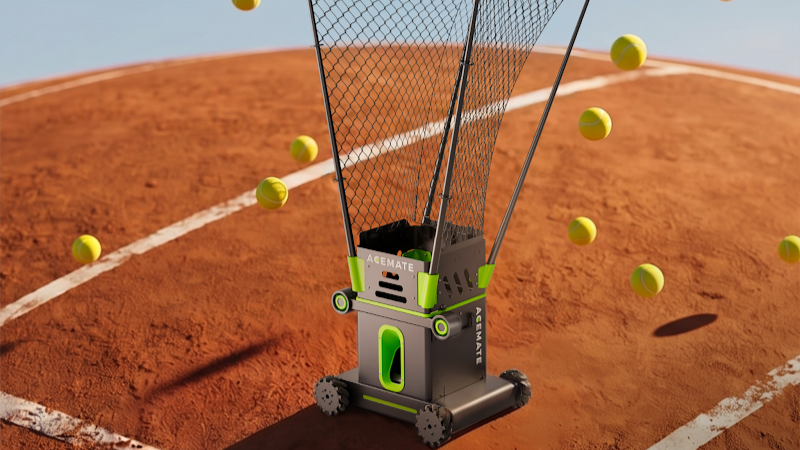
Save speed and spin changes for the gaps between blocks. How costly that is depends on the machine: if the controls sit on the unit, batch players by level and change once per block; if the settings live in an app on your phone, as they do on the Acemate S10, which is also controlled from an Apple Watch, per-block changes cost nothing. The S10 Pro adds gesture control alongside phone and smartwatch, and includes more than a hundred preset drills, so a block change can mean picking a preset instead of building a pattern shot by shot. Where the spread is wide, say a 3.0 and a 4.5 in the same group, the targets and tasks diverge far enough that they're better set by NTRP level than by drill.
Example 45-Minute Group Ball Machine Session
Here's a full session for four players on one court: two warm-up cycles, two working blocks with a scheduled reset between them, and a scored finish. Adjust the feed to your group's level and keep the shape.
|
Time |
Block |
Machine |
Roles |
|
0:00–0:05 |
Setup |
Off |
Mark the three zones, agree the safety rules, load the hopper |
|
0:05–0:12 |
Warm-up |
Slow center feed, long interval |
Full role wheel, six-ball turns, two cycles |
|
0:12–0:24 |
Block 1: crosscourt pattern |
Two corners alternating |
Two hitters at once, one collector, one on deck; swap halves at the midpoint |
|
0:24–0:27 |
Reset |
Paused |
Everyone collects, reload from the second bucket, water break |
|
0:27–0:38 |
Block 2: approach and volley |
Short ball, then a deeper feed |
Role wheel, six-ball turns; the caller hand-feeds the finishing volley |
|
0:38–0:45 |
Scoring game |
Same as Block 2 |
Eight balls each, one point per target zone; low score packs up the gear |
Two details make this work in practice: the reset at 0:24 is scheduled rather than improvised, and the last block has a score, so the group finishes competing instead of drifting. If you only have the court for half an hour, the same shape holds with one working block instead of two, which is how a 30-minute practice plan is built.
Common Group-Training Mistakes to Avoid
The mistake that ruins most group sessions is letting one player hit until the hopper's empty. Forty balls for the first person and a cold wait for everyone else. The rest are variations on the same theme of time and space:
- A waiting zone in the feed corridor. Players drift toward the center to watch. Point at where they should stand, once, at the start.
- Collecting during a live feed. It's the most common way someone gets hit and it's entirely avoidable. Pause, collect, restart.
- Reprogramming the machine every rotation. It doubles the time lost between turns. Batch the changes between blocks.
- No assigned collector. Balls pile up, then the whole group stops for four minutes to clear them.
- Identical drills regardless of level. Same feed is fine. Same target and same task usually isn't.
- Treating the machine as the whole session. Past four players it's one station out of two or three, and the session is better for it.
The rotation matters more than the hardware. Any tennis ball machine with an adjustable feed interval and at least two placements runs every setup above, from a basic feeder to a rally-capable robot. For a group or a club buying one, the specs that decide the session are feed control, hopper size, and how quickly settings change between blocks, which is where ball machines differ most in testing.
FAQ
Do you need a coach to run group ball machine drills?
No. Roles are enough: one person owns the timer, one owns the pickup, one calls targets. What you lose is technical correction, which the machine can't supply either, so groups without a coach get more out of scoring games than out of technique work.
How many tennis balls do you need for a group session?
Two hopper loads, so about 160 balls if your machine holds 80. One loaded hopper plus a full bucket courtside lets the collector reload without stopping the drill. Use consistent, dry practice balls; worn ones feed unpredictably.
Can you run doubles drills for a group with one ball machine?
Yes. Feed to one half from the center baseline so a doubles pair defends it together, with the second pair on deck. Alternating placements suit crosscourt and poach patterns, since the net player and the baseliner both have to read where the ball is going.
Are ball machines allowed on public tennis courts?
Policies vary by facility. Plenty of public parks restrict machines, limit them to off-peak hours, or ban them outright. Check before you plan a group session, since a group holds a court far longer than a solo hitter.
